Business leaders are expected to make decisions that shape the future of the organization. Whether the goal is driving innovation, improving customer outcomes, modernizing operations, reducing risk, or enabling growth, leaders are responsible for ensuring that change delivers measurable business results.
The challenge is that transformation rarely fails because of a lack of ambition. It fails because organizations struggle to maintain alignment between strategy, operations, technology, and delivery as change unfolds. As organizations become more complex, leaders are often forced to make decisions using fragmented reports, conflicting stakeholder input, and incomplete visibility into dependencies, risks, and trade-offs. Priorities that look aligned during planning can drift during execution, making it difficult to predict outcomes, control costs, and manage risk.
To lead transformation successfully, business leaders need more than dashboards and status updates. From Finance and Operations to Product, Engineering, HR, and Commercial teams, leaders need a shared view of how the organization works, what a decision will impact, and how strategic priorities remain connected to execution.
This is where collaboration with Enterprise Architecture (EA) is essential.
Challenges Business Leaders Face Today
Without connected view of the organization:
- Decisions made with incomplete information: Critical dependencies, risks, and trade-offs remain hidden until execution is already underway.
- Fragmented visibility across teams: Different departments operate from different reports, assumptions, and priorities.
- Strategy that drifts during execution: Initiatives that begin aligned to business goals often become disconnected as work progresses.
- Delayed decision-making: Leaders spend valuable time gathering information instead of acting on it.
- Limited visibility into impact: Costs, risks, and operational consequences are often discovered too late.
- Difficulty scaling innovation: Analytics, automation, AI, and modernization initiatives become harder to govern as complexity increases.
- Teams optimizing locally instead of moving together: Business, technology, and delivery teams often lack a shared understanding of priorities and outcomes.
These challenges make transformation slower, riskier, and more difficult to sustain.
Why Leaders Need Better Visibility
Every leadership decision creates consequences across the organization:
- A new product launch affects systems, processes, teams, and customers.
- A modernization initiative affects operations, budgets, vendors, and delivery teams.
- An AI investment affects governance, data, security, and business outcomes.
The challenge is that these relationships are rarely visible in one place.
Enterprise Architecture provides the foundation for this visibility, but the value for leaders is simple: understanding impact before change happens.
Instead of asking different teams for pieces of the answer, leaders can see how priorities, investments, systems, processes, and initiatives connect across the organization and make decisions with greater confidence.
Better Together: Business Leadership & Enterprise Architecture
What is Enterprise Architecture’s role?
Enterprise Architecture (EA) is a way of structuring how an organization understands and manages change.
It creates a connected view of:
- Business goals and strategic priorities.
- Business capabilities and operational processes.
- Applications, systems, and integrations.
- Data and information flows.
- Transformation initiatives and investments.
This creates a shared model of the enterprise in a current and future state, which helps organizations understand how change in one area affects everything else. For business leaders, EA provides something that is increasingly difficult to achieve: confidence.
- Confidence that decisions are based on facts rather than assumptions.
- Confidence that risks are understood before investments are made.
- Confidence that modernization efforts will not introduce unintended consequences.
- Confidence that goals can be achieved through the right approach.
Enterprise architects help maintain this visibility by connecting business strategy, operational reality, and technology execution into a single view of the organization.
Why an EA-Rooted Approach Improves Business Leadership Outcomes
Business leaders do not need more information. They need more clarity.
Enterprise Architecture helps solve this challenge by creating a shared view of how the organization operates.
Instead of relying on fragmented updates, managers can understand:
- How strategic priorities connect to execution.
- Which dependencies create risk.
- How systems, teams, and processes influence one another.
- Where investments create the greatest business impact.
- What will be affected before change occurs.
This enables decision-makers to move from guessing to knowing, making decisions with greater confidence while improving accountability and reducing risk.
How Leadership Changes with Enterprise Architecture
When EA becomes part of leadership’s decision-making, transformation becomes less about reacting to change and more about guiding it together.
Leaders gain a shared view of reality
Instead of relying on fragmented reports and after-the-fact updates, leaders can see how strategy, architecture, and delivery connect in real time.
Decisions become faster and better informed
Dependencies, risks, and trade-offs are known before decisions are made, reducing uncertainty and accelerating progress.
Teams stay aligned around shared priorities
As strategies evolve and priorities shift, EA helps leaders understand how changes affect initiatives, resources, systems, and business outcomes across the organization.
This ensures that architecture remains relevant to business goals, while teams remain aligned around the outcomes leadership is trying to achieve.
Change becomes more predictable and intentional
By combining business priorities with enterprise-wide visibility, organizations gain a clearer understanding of cost, impact, risk, and progress throughout delivery. This helps organizations move forward with greater confidence, fewer surprises, and a clearer path to achieving strategic goals.
Business Leaders Don’t Govern Alone
Modern transformation requires collaboration across multiple roles, including:
- Enterprise architects.
- Security and compliance teams.
- Program and transformation leaders.
- Operations teams.
Each contributing a different perspective on change.
BlueDolphin helps bring these perspectives together around a shared source of truth, allowing leaders to understand not only what is changing, but why it matters and who it affects.
What This Collaboration Looks Like in BlueDolphin
BlueDolphin helps decision-makers stop guessing their way through transformation.
By connecting strategy, architecture, and delivery into one shared environment, leaders gain visibility into how decisions affect the organization before change happens. They can communicate priorities and decisions more clearly across teams and departments. Decisions remain connected to their rationale, creating a lasting record that helps maintain alignment, accountability, and continuity over time.
Why This Is Different
Many tools support individual parts of transformation.
- Project management tools track tasks and milestones.
- Documentation tools capture information.
- Consulting engagements provide temporary expertise.
- Operational tools manage day-to-day execution.
But none of these create a persistent, governed view of how the organization fits together. BlueDolphin does.
By connecting architecture, strategy, operations, and transformation into a shared system of record, BlueDolphin helps organizations and teams maintain visibility and control across years of change.
Collaboration in Practice
See Clearly, Decide Confidently
Gain a real-time view of how strategy, technology, operations, and delivery connect. Understand dependencies, risks, and trade-offs before decisions are made.
This helps organizations to anticipate challenges, evaluate options earlier, and shape outcomes before they become problems. Instead of reacting to issues after they emerge, organizations can proactively guide change with greater confidence and control.
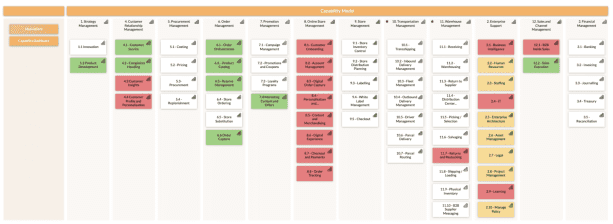
Capability map in BlueDolphin
Stay Aligned All the Way to Delivery
BlueDolphin helps organizations connect strategic priorities directly to architecture and execution, ensuring teams remain aligned as plans turn into action.
Executives and management can understand how priorities shift, how initiatives influence one another, and where intervention may be needed before execution drifts off course.
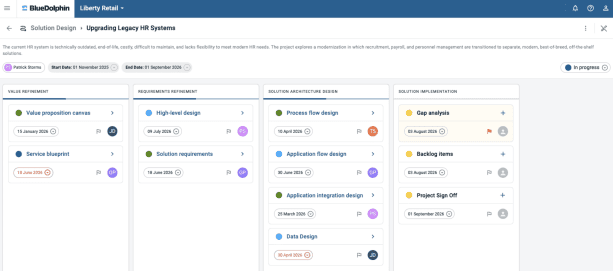
Design every step of your initiative in BlueDolphin
Make Change Stick and Reduce Failure
BlueDolphin creates a shared system where leaders can monitor impact, control risk, and maintain visibility across long-running transformation initiatives.
Instead of discovering issues after the fact, you can address them before they become obstacles.
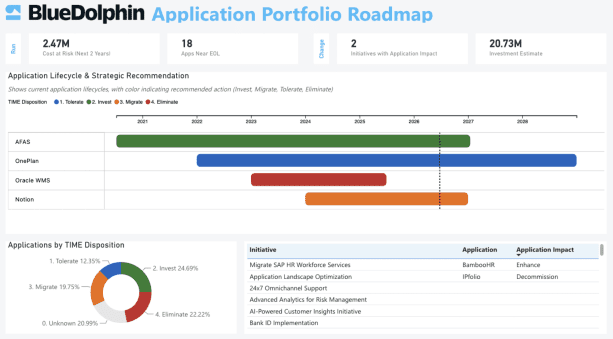
Impact analysis in BlueDolphin
Use AI to Reduce Guesswork
BlueDolphin AI gives business leaders direct access to the organization’s architecture and transformation knowledge through natural-language conversations. Instead of waiting for reports or specialist analysis from Enterprise Architecture teams, they can ask questions directly against their architecture environment and receive immediate, context-aware answers.
Leaders can ask questions such as:
- What business capabilities are affected by this initiative?
- Which dependencies create the highest risk?
- What is the impact of delaying this program?
- Which investments generate the greatest strategic value?
This transforms architecture from static documentation into a collaborative decision intelligence layer that helps leaders understand impact, make faster decisions, and contribute directly to transformation initiatives.
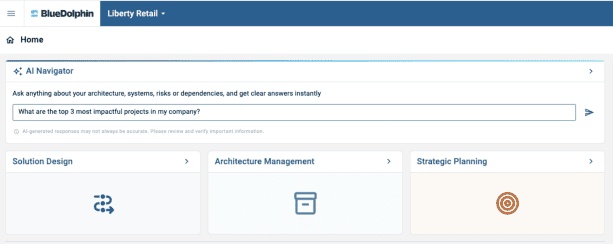
AI Navigator in BlueDolphin
Support Every Leader Driving Change
While Enterprise Architecture provides the foundation, BlueDolphin creates value across leadership teams.
For Finance Leaders
- Understand costs, dependencies, and investment impact before money is spent.
- Identify redundancy and rationalization opportunities.
- Improve investment prioritization and ROI visibility.
For Operations Leaders
- Visualize operational dependencies.
- Identify disruption risks earlier.
- Keep change moving while maintaining stability.
For IT Leaders
- Reduce complexity without losing control.
- Identify technical debt and risk.
- Strengthen governance and modernization efforts.
For Product and Engineering Leaders
- Understand enterprise impact before release.
- Reduce late-stage surprises and rework.
- Align roadmaps and delivery priorities.
Because everyone works from the same underlying information, decisions become easier, collaboration becomes stronger, and transformation becomes more predictable.
Move From Guesswork to Confidence
Business leaders understand where the organization needs to go. Enterprise architects understand how the organization fits together.
BlueDolphin brings strategy, architecture, and delivery together in a shared system that helps organizations see clearly, stay aligned, and make better decisions with confidence. Because transformation succeeds when everyone works from the same reality, and leaders can understand the impact before change happens.
Take the next step:
- Learn how BlueDolphin enables business leaders. Download the solution overview.
- Talk to our team to explore your solution delivery and transformation use cases in action.