Modern solution delivery is no longer just about designing systems that work. It is about designing solutions that fit into a constantly-evolving enterprise landscape, where transformation initiatives are continuous. Solution architects are expected to bridge business and technology while navigating growing complexity, tighter timelines, and constant change. But even the strongest technical designs can fail when they are disconnected from the organizational context, operational realities, or strategic direction.
Because of that, collaboration between solution architects and enterprise architects becomes essential. Enterprise architects provide the broader organizational context, ensuring solutions align with strategic goals, enterprise standards, and long-term transformation objectives. Solution architects and other project stakeholders contribute the practical delivery perspective, translating business needs into executable designs and implementation plans. Together, they create a shared understanding that helps organizations move from isolated solution delivery to connected transformation, where every stakeholder can contribute, collaborate, and make decisions using information relevant to their role.
Challenges Solution Architects Face Today
Solution architects are responsible for designing and implementing technology solutions that support business goals. Yet many still work in environments where information, dependencies, and decision-making are fragmented.
Without connected collaboration with enterprise architects and the broader organization, solution architects often face:
- Limited visibility into enterprise impact: Solutions are designed without full awareness of how they affect organization’s processes.
- Mismatches between current and target-state designs: Inconsistent or outdated information creates design gaps and rework.
- Difficulty communicating with non-technical stakeholders: Technical designs are often hard to translate into business impact.
- Disconnected solution decisions: Teams make architecture and implementation decisions without organizational context.
- Late discovery of dependencies and risks: Critical impacts only become visible during delivery or implementation.
- Lack of consistency and standardization: Different projects adopt different patterns, technologies, and approaches.
- Duplicate effort across projects: Architects repeatedly recreate information that already exists somewhere else in the organization.
Better Together: Solution Architects & Enterprise Architecture Collaboration
What is Enterprise Architecture’s role?
Enterprise Architecture (EA) is a way of structuring how an organization understands and manages change. It creates a connected view of how business goals, capabilities, processes, applications, data, and technology fit together across the organization.
EA connects strategy to execution by mapping relationships between:
- Business goals and outcomes.
- Capabilities and operational processes.
- Applications, integrations, and technologies.
- Data and information flows.
- Projects and transformation initiatives.
This creates a connected model of the business that allows organizations to understand how everything is interrelated.
Enterprise architects help organizations guide transformation by turning this connected enterprise view into practical direction and governance. They help define future-state architectures, identify gaps between current and target states, and ensure solutions align with broader organizational strategy.
Organizations that adopt an EA-rooted approach gain a major advantage: they can design solutions with enterprise-wide visibility rather than reacting to integration, operational, or governance issues later in delivery.
Why an EA-Rooted Approach Improves Solution Delivery
Solution delivery often struggles not because teams lack technical expertise, but because designs are created without enough enterprise context.
Bain & Company found that 88% of business transformations fail to achieve their original ambitions, often because execution and organizational alignment break down over time. McKinsey research also shows that organizations with stronger cross-functional collaboration are significantly more likely to succeed in transformation initiatives. For Solution Architects, these findings highlight a common reality: even well-designed technical solutions can fail when they are disconnected from the broader enterprise context. A solution may meet immediate project requirements, but still create downstream issues if dependencies, operational processes, integration impacts, governance requirements, or long-term architectural direction are not fully understood upfront.
Enterprise Architecture gives solution architects a connected view of the organization’s landscape before implementation begins. It exposes how systems, processes, data, and initiatives connect across the organization. With EA, solution architects can design with a clearer understanding of enterprise impact, governance expectations, and long-term transformation goals.
How Solution Delivery Changes With Enterprise Architecture
When Enterprise Architecture is embedded into solution delivery, it improves the operations across the lifecycle of change:
Solutions are designed within the enterprise context, not in isolation.
Without EA, solution design often starts at the project level with limited visibility into dependencies. With EA, designs are connected to capabilities, systems, processes, and strategic outcomes from the beginning.
Dependencies become visible earlier.
EA exposes risks and downstream impacts upfront, helping solution architects avoid costly surprises later in delivery.
Communication becomes easier across technical and business teams.
Enterprise Architecture provides shared visual models and business context that make solution intent easier to understand across the organization.
Design consistency improves across projects.
Without EA, projects often adopt inconsistent technologies, patterns, and approaches. With EA, solution architects can rely on shared standards, reusable architecture assets, and common design principles.
How Enterprise Architecture Improves Solution Architect Workflow and Outcomes
EA helps Solution Architects move from project-by-project design toward connected, enterprise-aware solution delivery.
For daily workflows, EA provides:
- Reusable architecture data and models.
- Clear visibility into systems, integrations, and dependencies.
- Better collaboration across business and IT.
- Shared standards and governance guidance.
- Easier access to enterprise-wide information.
EA helps reduce rework, improve alignment, increase consistency, strengthen scalability, and ensure solutions support long-term transformation goals rather than short-term project needs alone.
Why This Matters
When solution architects work without enterprise-wide visibility, the consequences extend beyond technical design issues. Disconnected solutions increase operational complexity, create integration challenges, and slow delivery. This leads to duplicated effort, reduced agility, and growing technical debt that makes future transformation harder to execute.
Organizations that connect Solution Architecture to Enterprise Architecture gain a more coordinated approach to change, where solutions are designed with full awareness of the systems, processes, and business outcomes they support.
What Solution Design Looks Like in BlueDolphin
In BlueDolphin, this connected way of working becomes practical and accessible. BlueDolphin acts as a central connecting layer across the enterprise ecosystem, linking solution design to business capabilities, applications, processes, data, and transformation initiatives.
By connecting architecture, strategy, and execution in a unique visual way, BlueDolphin helps solution architects design solutions with a clearer understanding of business impact, dependencies, and long-term transformation goals.
A Better-Together Model
- Enterprise architects provide structure, governance, and enterprise-wide visibility.
- Solution architects design executable solutions aligned to business and technical goals.
- Rest of the organization understands solution impact through shared enterprise context.
Together, they move from isolated solution delivery to coordinated, enterprise-aware transformation.
Collaboration in Practice
Start with a visual design, not a blank document
Solution Design begins with making ideas tangible. Whether teams are exploring a new business capability, redesigning a process, integrating applications, or planning a major transformation initiative, BlueDolphin allows solution architects and stakeholders to start with a visual representation of the solution from day one, using:
- Pre-built templates for common architecture and transformation scenarios.
- Freeform whiteboarding for early ideation and exploration.
- Existing architecture objects, applications, processes, capabilities, and data from the repository.
- AI-assisted diagram generation to accelerate design creation.
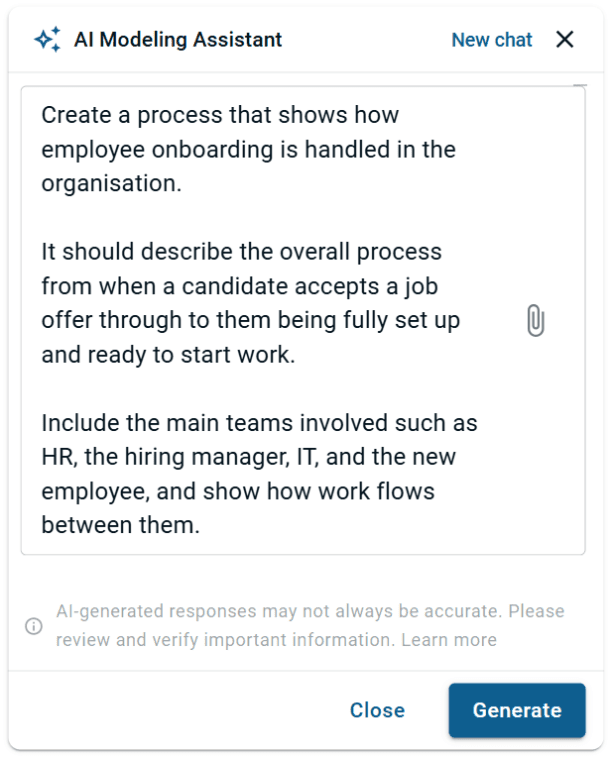
AI Modeling Assistant in BlueDolphin
Align every design to Enterprise Architecture and strategy
Solution architects can connect solution designs directly to enterprise capabilities, systems, and strategic initiatives to ensure alignment from the start. This allows solution architects to understand how a proposed solution contributes to broader transformation goals while ensuring alignment with enterprise standards and target-state architecture.
Rather than designing in isolation, teams can continuously validate that solutions support the direction of the organization.
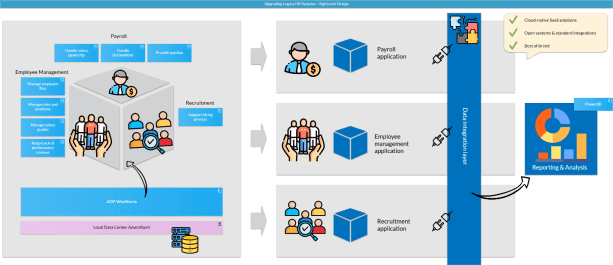
Solution Design in BlueDolphin
Use AI to make Solution Design easy for everybody to understand
BlueDolphin AI acts as an intelligence layer across solution design, helping teams move from ideas to executable solutions faster and with greater confidence.
Teams can:
- Start new initiatives using our AI Value Proposition Canvas Generator, which helps structure project outcomes, stakeholders, value drivers, and business impact before design work begins.
- Use the AI Modeling Assistant to generate BPMN diagrams and execution-ready process designs from prompts, sketches, existing documentation, or repository context.
- Leverage AI View Assistants to analyze BPMN, ArchiMate, and freeform diagrams, automatically identifying gaps, weak dependencies, missing relationships, and design inconsistencies.
- Ask the AI Navigator natural-language questions about architecture, integrations, dependencies, risks, costs, and strategic impact to gain immediate decision support.
Check out our product overview here.

Dependency and integration visibility
Architects gain visibility into how systems, applications, and integrations interact across the enterprise before implementation begins.
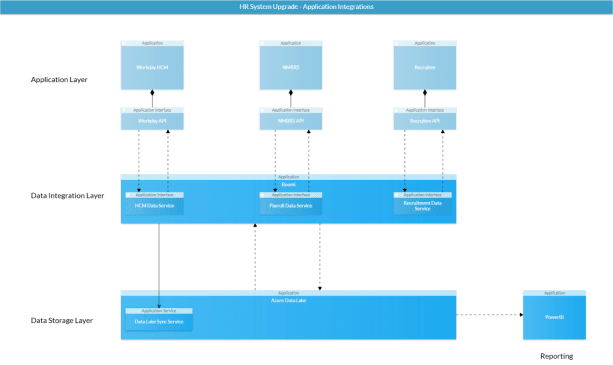
Reveal application dependencies in BlueDolphin
Current-state and target-state transformation planning
BlueDolphin allows solution architects to model alternative scenarios, compare future states, and evaluate different approaches before implementation begins. Teams can build transition architectures, assess trade-offs, visualize impacts, and compare options against business objectives, architecture principles, and implementation risks. This enables more informed decision-making while reducing the likelihood of costly redesigns later in delivery.
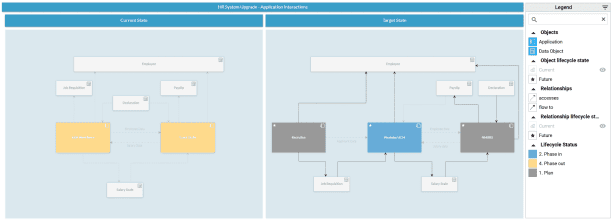
Analyze current and future states with BlueDolphin’s Solution Design
Cross-functional collaboration
Solution design is not owned by architects alone.
Sponsors, business analysts, project managers, application owners, security officers, key users, and technical specialists all contribute to shaping a successful solution.
BlueDolphin provides a collaborative environment where stakeholders can co-create, review, comment, and refine solution designs together.
Through our AI assistants, multi-user editing, task management, and review workflows, teams can assign actions, request feedback, track progress, and maintain alignment without relying on endless meetings and email chains.
With BlueDolphin AI, they can ask natural-language questions such as:
- “What systems are impacted by this design?”
- “Which integrations create the highest dependency risk?”
- “Where does this solution conflict with current architecture standards?”
This enables faster analysis, stronger collaboration, and more confident solution decisions.
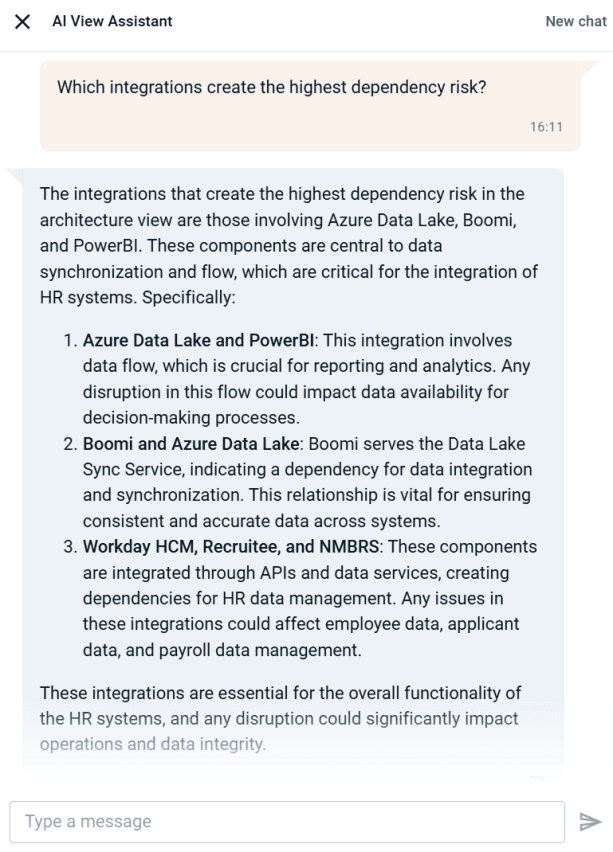
Anyone can ask questions about the architecture with BlueDolphin AI
Governance, consistency, and reusable standards
BlueDolphin helps organizations move beyond isolated project delivery by embedding governance and architectural consistency directly into the solution design process.
Solution Architects can work from reusable templates, shared design standards, and connected architecture principles that guide delivery without slowing it down. This ensures teams can innovate while still maintaining alignment with enterprise-wide standards and long-term transformation goals.
Move From Solution Design to Connected Transformation
BlueDolphin connects strategy, architecture, and solution delivery into one continuous flow, so every solution is designed with full organizational context, every dependency is visible, and every initiative contributes to long-term business outcomes.
Take the next step:
- Learn about Solution Design in BlueDolphin. Download the solution brief.
- Talk to our team to explore your solution delivery and transformation use cases in action.