
Processes don’t exist in isolation. A single operational workflow may depend on multiple teams, applications, data sources, and policies working together across the business. During times of business transformation, even small process changes can create ripple effects that extend beyond their original scope.
For process owners, this creates a challenge: maintaining process quality and operational consistency while navigating constant organizational change. Understanding how a process connects to supporting systems, upstream and downstream workflows, and ongoing transformation initiatives is essential to avoid disruption and improve efficiency.
To manage this effectively, process owners need a connected view of how their business processes, BPMN models, supporting systems, and operational workflows fit into the broader organization. This enables them to collaborate across teams, anticipate impact earlier, and guide operational change with greater clarity and confidence.
Challenges Process Owners Face Today
Process owners are expected to maintain clarity, consistency, and efficiency across critical business processes. Yet many still operate in environments where process knowledge, ownership, and system relationships are fragmented.
Process owners often face:
- Limited end-to-end process visibility: Processes are documented in isolation, making it difficult to understand how they connect to upstream and downstream activities.
- Unclear system support: Lack of visibility into which applications, data, or technologies support their processes.
- Late surprises during execution: Dependencies and impacts only become visible once projects or operational changes are already in progress.
- Poor insight into downstream impact: Changes to one process can unintentionally disrupt related processes, teams, or systems.
- Outdated or inconsistent process documentation: Process models quickly become disconnected from operational reality.
- Unclear ownership and responsibilities: Teams struggle with RASCI alignment and accountability across processes.
- Difficulty collaborating across teams: Process discussions often happen separately from project, architecture, or technology conversations.
Better Together: Process Owners & Enterprise Architecture Collaboration
What is Enterprise Architecture’s role?
Enterprise Architecture (EA) provides a connected view of how strategy, operations, processes, applications, data, and technology work together across the organization.
In practice, EA connects strategy to execution by mapping relationships between:
- Business goals and outcomes.
- Capabilities and processes.
- Applications, data, and technology.
- Projects and transformation initiatives.
This allows organizations to understand not just what they are doing, but how everything is interrelated.
For process owners, EA provides critical context for understanding how operational processes interact with the broader enterprise landscape.
Enterprise architects support transformation by turning this connected view into actionable guidance. They help organizations define future-state operating models, identify gaps between current and target states, and expose dependencies, risks, and impacts before changes are implemented. Rather than reacting to operational issues after they emerge, Enterprise Architecture helps organizations anticipate and guide change proactively.
Why an EA-Rooted Approach Improves Process Management
Operational issues rarely happen because of one isolated process failure. More often, they occur because processes, systems, and teams are disconnected. As organizations become more complex, Process Owners increasingly struggle to understand how operational changes affect the broader business landscape.
This challenge has measurable business consequences. Bain & Company found that 88% of business transformations fail to achieve their original ambitions, often because execution, operations, and strategic change become disconnected over time. Research from McKinsey also shows that organizations with strong cross-functional collaboration and operational alignment are significantly more likely to succeed in transformation initiatives.
Enterprise Architecture creates visibility into how business processes relate to applications, data, capabilities, and transformation initiatives across the organization. Rather than viewing processes in isolation, EA provides process owners with a connected understanding of operational dependencies, supporting systems, and downstream impact.
For process owners, this means:
- Better visibility into how processes connect.
- Clear understanding of supporting systems and data.
- Earlier identification of risks and downstream impacts.
- More consistent collaboration with project, IT, and transformation teams.
This is especially important because process improvements often fail when operational changes are disconnected from technology and transformation initiatives happening elsewhere in the organization.
How Process Management Changes With Enterprise Architecture
When Enterprise Architecture is embedded into process management, it fundamentally changes how process owners operate across the lifecycle of change:
Business processes become connected, not isolated.
Without EA, process mapping often happens independently within departments. With EA, processes are connected to capabilities, applications, data, and strategic outcomes, creating true end-to-end visibility.
Dependencies become visible early.
Without architectural context, downstream impacts are often discovered late during projects or operational changes. EA exposes dependencies upfront, helping Process Owners anticipate disruption before execution begins.
Collaboration becomes cross-functional.
In fragmented environments, process discussions happen separately from project, architecture, and IT conversations. With EA, Process Owners collaborate within a shared enterprise context alongside architects, project teams, and operational stakeholders.
Process success moves beyond documentation to operational impact.
Traditional process management often focuses on maintaining diagrams, BPMN documentation, and compliance records. With EA, processes are evaluated based on operational effectiveness, business outcomes, and their contribution to enterprise transformation.
Where Process Owners and EA Work Together
Process owners and Enterprise Architecture overlap most at the critical moments where operational processes intersect with organizational change. These include process improvement initiatives, system implementations, transformation programs, governance, and operational impact analysis.
In an EA-rooted approach, these moments become shared points of collaboration, where both functions operate from the same connected view of the organization. This enables:
- Processes to be evaluated in context: Processes are no longer viewed in isolation, but in relation to business capabilities, systems, and enterprise outcomes.
- Early visibility into dependencies: Relationships between processes, supporting applications, and data become visible upfront, reducing operational surprises.
- Embedded governance: Process standards, ownership, and compliance are continuously connected to operational and transformation workflows.
- Connected reporting: Process information is no longer fragmented across documents and teams, but drawn from a single, connected source of truth.
Together, this overlap allows process owners and enterprise architects to operate as a coordinated system, improving visibility, collaboration, and operational resilience.
Why This Matters
When process owners operate without this connected approach, the impact extends far beyond process inefficiency. Poor visibility into dependencies and downstream impact increases operational risk, slows transformation efforts, and creates costly surprises during execution. Over time, disconnected processes lead to inconsistent operations, reduced process quality, and growing friction between business and IT teams.
Organizations that connect process management to Enterprise Architecture gain a clearer understanding of how workflows across the organization, enabling more resilient operations and more successful transformation outcomes.

What Process Management Looks Like in BlueDolphin
In BlueDolphin, this connected way of working becomes practical and accessible. Collaboration between process owners, enterprise architects, and the broader organization happens in day-to-day work moments, where shared data and models provide the context needed for better operational decisions.
BlueDolphin acts as a central connecting layer across the enterprise ecosystem, linking processes to the systems, applications, projects, and transformation initiatives that shape them. Rather than replacing operational or project tools, BlueDolphin connects the dots between them, creating shared visibility across the organization.
Why This is Different
Not all Enterprise Architecture or transformation platforms enable this level of collaboration.
- Traditional EA tools often focus on documentation and analysis, which can make process insight difficult to access for operational stakeholders.
- Whiteboarding tools support visualization, but typically lack the underlying data.
- Operational and project tools excel at managing daily work, but often operate without visibility into enterprise-wide process dependencies and impact.
BlueDolphin brings these worlds together into a single, connected platform where process management, architecture, and execution continuously inform one another.
A Better-Together Model
- Enterprise architects provide structure, context, and enterprise-wide visibility.
- Process owners guide process quality, operational consistency, and continuous improvement.
- Rest of the organization makes informed decisions based on shared process and architecture insight
Together, they move from managing processes in isolation to guiding operational transformation as a connected, enterprise-wide flow.

Collaboration in Practice
End-to-end process visibility
Process owners can connect business processes to capabilities, applications, and supporting systems to understand how work flows across the organization.
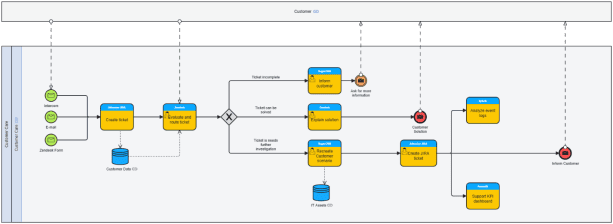
[BPMN Process View in BlueDolphin]
Understanding system support
Process owners gain visibility into which systems, applications, and data support each process, reducing uncertainty during operational or transformation changes.
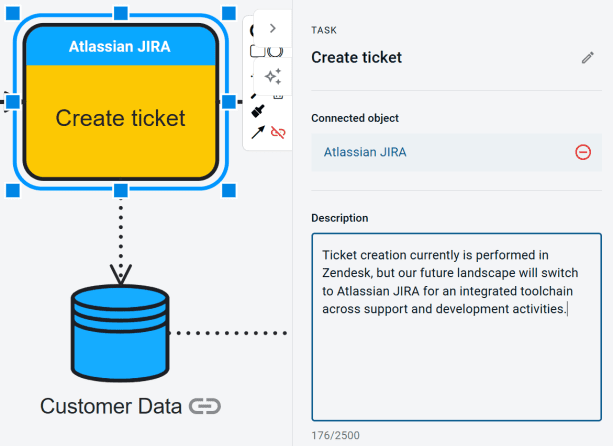
[Process to Application Description in BlueDolphin]
Process impact analysis
Before operational changes are implemented, Process Owners can evaluate downstream impacts across teams, systems, and related processes.
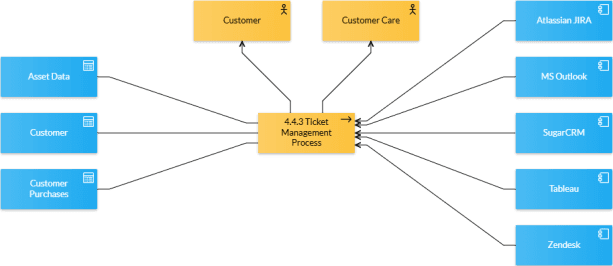
[Process Impact Analysis View in BlueDolphin]
Process and project collaboration
Process Owners collaborate directly with project and transformation teams to ensure operational processes remain aligned throughout execution.
Governance and ownership clarity
BlueDolphin helps organizations maintain clear RASCI ownership and governance across operational processes.
AI-driven process insights
Process Owners can ask natural-language questions such as:
- “Which systems support this process?”
- “What downstream processes are affected by this change?”
- “Where are there gaps in process ownership?”
This enables faster analysis, stronger collaboration, and more confident operational decisions.
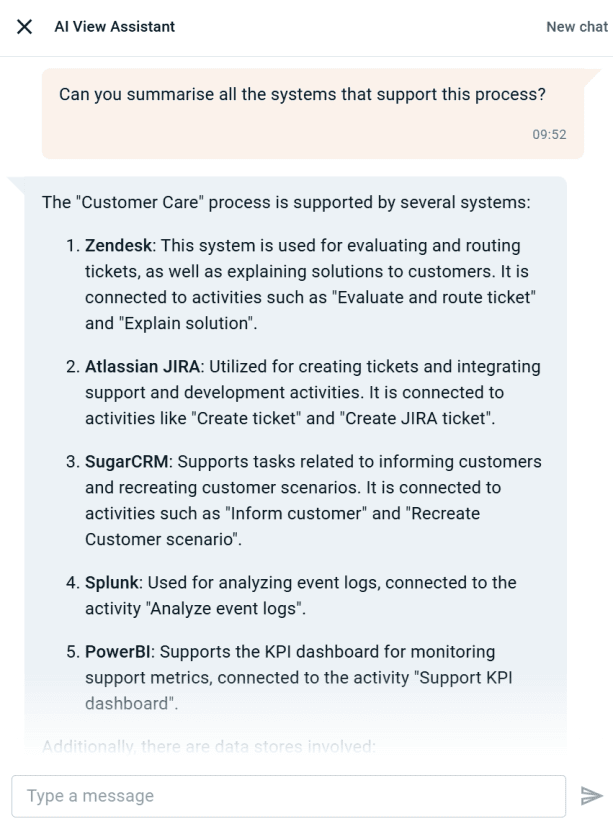
[AI View Assistant Chat in BlueDolphin]
Move From Process Visibility to Operational Impact
BlueDolphin connects process management, architecture, and execution into one continuous flow, so every process change is informed, every dependency is visible, and every operational improvement contributes to broader business outcomes.
Take the next step:
- Learn how Business Process Management works together in BlueDolphin. Download the solution brief.
- Talk to our team to explore your operational and transformation use cases in action.