
In today’s business world, change is no longer a discrete event but a constant state of motion. Organizations are under relentless pressure to adapt, evolve, and deliver outcomes faster, yet most still struggle to translate strategy into execution.
The Project Management Office (PMO) plays a critical role as the orchestrator of transformation, responsible for turning ambition into coordinated action across portfolios of initiatives. But the nature of transformation has changed. It is no longer linear, predictable, or contained within projects. It is continuous, interconnected, and shaped by dependencies that span the entire enterprise.
To succeed in this environment, PMOs must move beyond coordination alone. They must operate within a connected system where strategy, architecture, and execution continuously inform one another, creating a shared foundation for decisions, alignment, and impact across the organization.
Challenges of Project Managers today
PMOs are expected to provide clarity, control, and alignment across an increasingly complex portfolio. Yet most operate in environments where information, decisions, and dependencies are fragmented.
Without connected collaboration with enterprise architects and the rest of the organization, PMOs often face:
Fragmented portfolio visibility: Project data is scattered across tools and teams, making it difficult to get a single, reliable view of the full portfolio.
Hidden dependencies and risks: Critical dependencies between projects, systems, and processes remain invisible until they cause delays or failures.
Reactive decision-making: PMOs are forced to make decisions after issues arise because they lack real-time, connected insight, and are often already focused on the planning phase.
Operational inefficiencies: Manual reporting and duplicated data entry consume time and slow down portfolio management.
Lack of alignment across teams: Strategy, architecture, and execution operate in silos, causing initiatives to drift away from business goals.
Budget overruns and missed timelines: Poor visibility into impact and dependencies leads to underestimated effort, risks and cascading delays.
Missed opportunities and reduced impact: Without a connected view, PMOs struggle to identify high-value initiatives and optimize the portfolio.
Individually or collectively, these challenges keep PMOs operating in a tactical, reactive mode, limiting their ability to step up as strategic drivers of progress and meaningful business outcomes.
Better Together: PMO & Enterprise Architecture Collaboration
What is Enterprise Architecture’s role?
Enterprise Architecture (EA) is not just a technical discipline. It is a way of structuring how an organization understands and manages change.
In practice, EA connects strategy to execution by mapping relationships between:
- Business goals and outcomes
- Capabilities and processes
- Applications, data, and technology
- Projects and transformation initiatives
This creates a shared, connected model of the enterprise, allowing organizations to understand not just what they are doing, but how everything is interrelated.
Enterprise Architects play a critical role in supporting strategic change by turning this connected view into actionable guidance. They help organizations define future-state architectures, identify gaps between current and target states, and map the initiatives required to close those gaps. By making dependencies, risks, and impacts visible, they enable better planning, more informed decision-making, and stronger alignment between business and IT. Rather than reacting to change, Enterprise Architects help shape it, ensuring that transformation initiatives are feasible, aligned, and built to deliver lasting outcomes.
Not every organization with a PMO and EA has these roles collaborate closely with each other. But those that adopt an EA-rooted approach gain a critical advantage: they are able to see the full picture before acting, rather than reacting to issues as they arise.
Why an EA-rooted approach improves project delivery
Project delivery often breaks down not because teams lack effort, but because strategy, design, and execution drift apart. Bain & Company found that 88% of business transformations fail to achieve their original ambitions, often due to weak engagement, insufficient capabilities, and execution gaps.
Enterprise Architecture helps improve these odds by giving organizations a structured method for connecting business intent to operational reality. It maps how goals, capabilities, processes, applications, data, technology, and initiatives relate to one another, creating a shared view that teams can use to plan, prioritize, govern, and adapt. Gartner describes modern Enterprise Architecture as a function that can help evolve operating models, establish enterprise-wide principles, and support governance in response to changing business priorities.
For PMOs, this means project delivery becomes less dependent on fragmented reporting and more grounded in the enterprise context. Enterprise Architecture helps PMOs understand what each initiative affects, which dependencies matter, where risks may emerge, and how each project contributes to strategic outcomes. This is especially important because strategy execution often fails when resources, priorities, and responsibilities are not clearly aligned. Harvard Business School notes that ineffective resource allocation is one of the common reasons strategic plans fail.
How Project Management Changes With Enterprise Architecture
When Enterprise Architecture is embedded into the way projects are planned and delivered, it fundamentally changes how PMOs operate across the entire lifecycle:
Planning starts from the enterprise, not the project.
Without Enterprise Architecture, planning begins in isolation at the project level. With EA, it starts from a connected view of strategy, capabilities, and current-state reality, ensuring every initiative fits into a bigger, coordinated plan.
Decisions shift from reactive to informed.
In fragmented environments, decisions rely on meetings and incomplete data. EA provides a shared, real-time view of dependencies, risks, and impact, enabling faster and more confident decision-making.
Risks and dependencies become visible early.
Without EA, risks surface during execution when it is too late. EA exposes dependencies upfront, allowing PMOs to anticipate challenges and reduce delays and rework.
Success moves beyond delivery to impact.
Traditional project management focuses on time, budget, and scope. With EA, success is also measured by strategic alignment, business outcomes, and long-term value across the organization.
How EA Improves PMO Workflow and Outcomes
An EA-rooted approach helps PMOs shift from project tracking to transformation orchestration. It improves the PMO workflow by giving teams a clearer way to prioritize initiatives, assess impact, manage dependencies, and govern decisions before work moves too far downstream.
For project outcomes, EA helps reduce rework, improve alignment, expose risks earlier, and strengthen confidence that funded initiatives are contributing to business goals. It also gives PMOs a more reliable basis for stakeholder conversations because decisions are grounded in a shared view of how the organization works, not disconnected updates from separate teams.
Where PMO and EA Meet
PMO and Enterprise Architecture overlap most at the critical moments where decisions shape both delivery and long-term business outcomes. These include portfolio planning, budget allocation, project initiation, solution design, governance, and execution tracking.
In an EA-rooted approach, these moments become shared points of collaboration, where both functions operate from the same connected view of the enterprise. This enables:
- Projects to be evaluated in context: Initiatives are no longer assessed in isolation, but in relation to strategy and enterprise impact.
- Early visibility into dependencies: Dependencies are not discovered late, but made visible upfront through architecture models, reducing risk and rework.
- Embedded governance: Governance shifts from reactive checkpoints to a continuous process guided by consistent structures, principles, and traceability.
- Connected reporting: Reporting is no longer fragmented across tools and teams, but drawn from a single, connected source of truth.
Together, this overlap allows PMOs and Enterprise Architects to operate as a coordinated system, improving decision-making, strengthening alignment, and increasing the overall impact of transformation initiatives.
Learn more about how Project Management and Enterprise Architecture work together in BlueDolphin. Download the solution brief
Why This Matters
When the Project Management Office operates without this connected approach, the consequences extend beyond inefficiency.
Decisions made in isolation increase risk, slow down execution, and reduce the impact of transformation initiatives. Over time, this leads to wasted investment, reduced stakeholder confidence, and a growing gap between strategy and results, reinforcing transformation theater rather than enabling meaningful, lasting change.
What Project Management Looks Like in BlueDolphin
In BlueDolphin, this connected way of working becomes practical and accessible. Collaboration between PMOs, enterprise architects, and the broader organization happens in day-to-day work moments, where shared data and models provide the context needed for better decisions.
BlueDolphin acts as a central connecting layer across the enterprise ecosystem, linking strategy and architecture to the systems teams already use to execute work, such as development environments, project and resource planning tools, and operational platforms.
By connecting these dots, BlueDolphin creates a shared understanding of how initiatives relate to the broader organization, ensuring that strategy, architecture, and execution stay aligned without forcing PMOs to change how they manage delivery in their existing tools.
Why This is Different
Not all Enterprise Architecture or transformation platforms enable this level of collaboration.
- Traditional EA tools often focus on documentation and analysis, which can make insights less accessible for non-architect stakeholders.
- Whiteboarding and diagramming tools support visualization, but typically lack the underlying data, relationships, and governance needed to carry insights into execution.
- Project and delivery tools excel at managing day-to-day work, but often operate without full architectural context.
BlueDolphin brings these worlds together into a single, connected platform where strategy, architecture, and execution continuously inform one another.
A better-together model
- Enterprise Architects provide structure, context, and foresight.
- PMOs drive prioritization, governance, and execution.
- Rest of the organization makes informed, outcome-driven decisions based on shared insight.
Together, they move from managing projects to guiding transformation as a coordinated, insight-driven flow, ensuring that change is not just delivered, but delivered with clarity, alignment, and lasting impact.
Collaboration in Practice
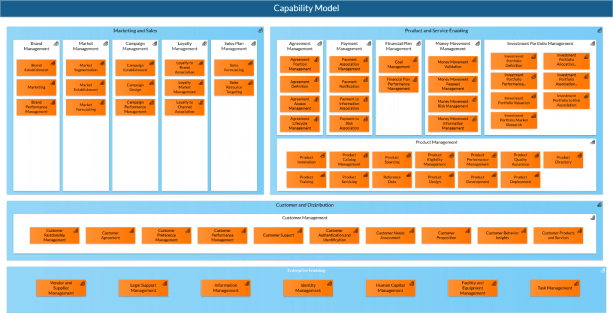
Long-term strategic planning
PMOs can align the organization on the portfolio by linking:
- Strategic goals
- Capabilities
- Initiatives
This creates a clear line of sight from strategy to execution, ensuring that:
- Every project supports business outcomes.
- Redundant or low-value initiatives are identified early.
- Investment decisions are grounded in architecture insight.
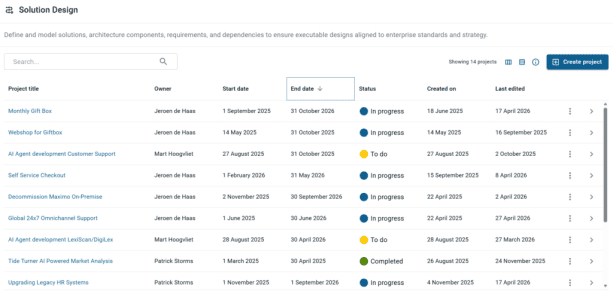
Budget planning and prioritization
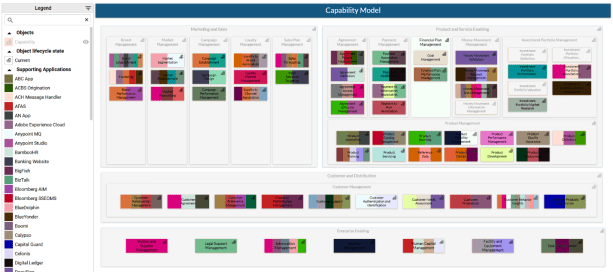
Instead of evaluating projects in isolation, PMOs can:
- Assess cost, value, and impact across the full portfolio.
- Understand which capabilities and systems are affected.
- Prioritize investments based on real dependencies and risks.
Architecture data provides the context needed to make confident trade-offs.
Solution architecture alignment
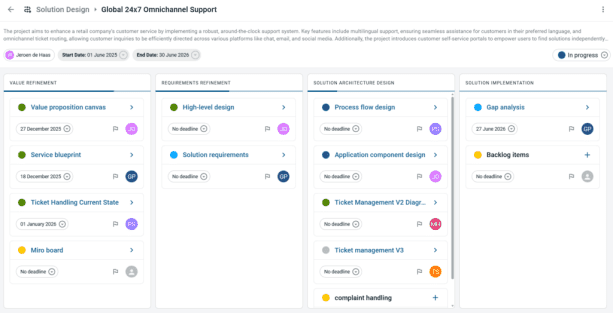
During project initiation and design:
- Enterprise architects define solution boundaries, dependencies, and constraints.
- PMOs build on these designs and ensure they align.
In BlueDolphin, this happens in a shared environment where:
- Architecture models are directly linked to projects.
- Dependencies are visible and traceable.
- Risks are identified before execution begins.
This reduces rework and prevents downstream issues.
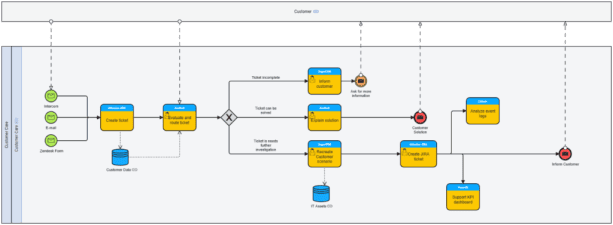
Process and workflow management
PMOs gain visibility into how projects impact:
- Business processes
- Data flows
- Application landscapes
By connecting process models and architecture data:
- Changes are evaluated in context.
- Cross-team impacts are understood.
- Execution becomes more predictable.
Project approvals and governance
Governance shifts from static checkpoints to continuous, data-driven oversight:
- Architecture principles and standards are embedded in workflows.
- Projects are evaluated against real-time architecture data.
- Approvals are based on impact, alignment, and risk.
This ensures that governance is both rigorous and agile.
Project pacing and execution tracking
During delivery, PMOs can:
- Track progress against architecture-defined milestones.
- Monitor dependencies across projects.
- Identify risks and bottlenecks early.
Because all data is connected, updates in one area immediately reflect across the portfolio. This enables:
- More reliable and faster decision-making.
- Better coordination across teams.
- More predictable delivery outcomes.
Dependency and impact analysis
One of the most critical collaboration moments is understanding impact:
- What happens if a project is delayed?
- Which systems or processes are affected?
- Where are the risks to business continuity?
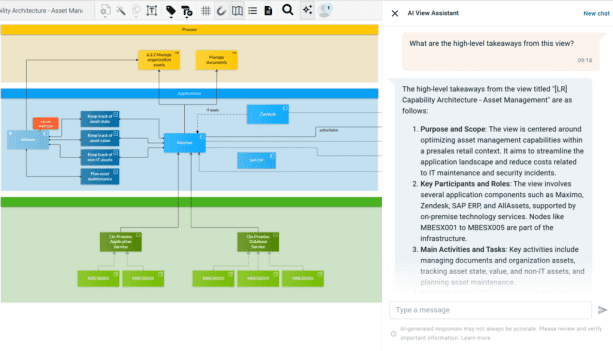
With BlueDolphin, PMOs can instantly explore these questions using connected architecture data and AI-powered insights, turning complexity into actionable clarity.
AI-driven insights and decision support
In BlueDolphin, PMOs can search for answers simply by asking natural-language questions such as “Which projects are at risk?” and receive immediate, context-aware answers based on live architecture data. This enables faster, more confident decisions and reduces reliance on manual analysis.
Move from Insight to Impact
BlueDolphin connects strategy, architecture, and execution into one continuous flow—so every decision is informed, every dependency is visible, and every initiative drives measurable impact.
Take the next step:
- Download the solution brief to learn how Project Management and Solution Architecture work together in BlueDolphin
- Talk to our team to explore your use case in action and see how it works in your organization