
Business analysts sit at the intersection of business and technology. They are responsible for understanding how the organization works today, identifying opportunities for improvement, and translating business needs into actionable change. In many ways, they are the ones who connect the dots. They bring together stakeholder needs, process knowledge, operational realities, and technology requirements to help organizations make better decisions.
But as organizations become more complex, this role becomes increasingly difficult. Processes span multiple departments, applications support dozens of business functions, and transformation initiatives generate large volumes of requirements, data, and stakeholder feedback. The challenge is no longer gathering information – it is connecting it.
To deliver meaningful outcomes, Business Analysts need visibility beyond individual requirements and processes. They need to understand how business needs connect to systems, data, architecture, and strategic objectives. This is where collaborating with Enterprise Architecture (EA) can be critical. Together, business analysts and enterprise architects can create a shared understanding of the organization that helps teams move from fragmented analysis to connected decision-making and successful transformation.
Challenges Business Analysts Face Today
Business analysts are expected to bridge the gap between business and IT while driving process improvement and decision-making. However, many still operate in environments where information is fragmented and difficult to connect.
Without connected collaboration with the broader organization, business analysts often face:
- Time-consuming search for information: Critical process, application, and data information is scattered across teams and tools.
- Lack of understanding between business and IT: Translating requirements and priorities between technical and non-technical stakeholders can be slow and difficult.
- Limited visibility into business impact: Requirements and process changes are often evaluated without understanding downstream effects.
- Disconnected management of requirements: Requirements live in documents, spreadsheets, tickets, and presentations with little traceability.
- Difficulty identifying automation opportunities: Fragmented process and application data make it hard to spot areas for optimization.
- Manual impact analysis: Understanding how proposed changes affect processes, applications, data, and teams often requires significant effort.
- Difficulty in operationalizing workshop outputs: Valuable insights often remain trapped in notes, recordings, and whiteboards rather than becoming structured knowledge.
As a result, business analysts often spend more time searching for information, validating assumptions, and aligning stakeholders than generating insight. Opportunities for improvement can be difficult to identify, recommendations can be difficult to justify, and valuable analysis can become disconnected from implementation.
Better Together: Business Analysts & Enterprise Architecture Collaboration
What is Enterprise Architecture’s role?
Enterprise Architecture is a way of structuring how an organization understands and manages change. It creates a connected view of business goals, capabilities, processes, applications, data, and technology.
In practice, EA connects strategy to execution by mapping relationships between:
- Business goals and outcomes.
- Business capabilities and processes.
- Applications, data, and technology.
- Projects and transformation initiatives.
This creates a shared model of the enterprise that allows organizations to understand not just what they are doing, but how everything is connected.
For business analysts, Enterprise Architecture provides the context that transforms individual requirements into meaningful business insight. Instead of analyzing a process, application, or requirement in isolation, analysts can understand how it contributes to broader business objectives and operational outcomes.
Enterprise architects help maintain this connected view, ensuring that information remains structured, governed, and reusable across the organization.
By working closely together, business analysts and enterprise architects can move from gathering information to generating actionable insight.
Why an EA-Rooted Approach Improves Business Analysis
Business analysts are expected to turn information into action. Yet in many organizations, the information they need is spread across processes, applications, documents, spreadsheets, workshops, and stakeholder conversations. The challenge is rarely a lack of data. The challenge is connecting it.
This problem has become increasingly important as organizations accelerate digital transformation. According to Gartner, poor data quality costs organizations an average of $12.9 million annually. For business analysts, this often means spending more time gathering information than analyzing it. As a result, opportunities for optimization, automation, and improvement can be difficult to identify and even harder to prioritize.
Business analysts are most effective when they can connect information across the organization. Enterprise Architecture provides the context that makes this possible. Rather than treating processes, requirements, applications, data, and projects as separate artifacts, analysts can understand how they relate to one another and what impact proposed changes will have.
This changes the role of the business analyst in several ways:
- Requirements become traceable. Business needs can be connected directly to processes, applications, data, capabilities, and strategic objectives.
- Business and IT speak the same language. Shared architecture models provide a common frame of reference that improves communication and alignment.
- Process analysis becomes more actionable. Analysts can identify how processes are supported by applications, data, and technology, making automation opportunities easier to uncover.
- Impact analysis becomes faster and more reliable. Instead of manually investigating dependencies, analysts can immediately understand what a proposed change affects.
- Recommendations become easier to execute. Because analysis is connected to architecture and implementation context, opportunities can move more smoothly into solution design and delivery.
For business analysts, Enterprise Architecture transforms analysis into a structured discipline that connects business insight directly to organizational change. Instead of asking, “What is happening?” analysts can begin answering the more valuable question: “What should we do next, and what will it impact?”
Business Analysts Don’t Work Alone
Business analysts rarely work in isolation. They collaborate with process owners, enterprise architects, solution architects, project teams, product owners, subject matter experts, and business stakeholders throughout the lifecycle of change.
Yet the information each group contributes is often stored separately in documents, spreadsheets, tickets, process models, presentations, and project tools.
BlueDolphin helps bring these perspectives together around a shared source of truth. Instead of repeatedly collecting, validating, and reconciling information, business analysts can work from a connected view of the organization where requirements, processes, applications, data, and initiatives remain linked.
Where Business Analysts and EA Overlap
Business analysts and Enterprise Architecture overlap most where understanding meets execution.
These moments include:
- Process analysis and improvement.
- Requirements gathering and management.
- Business capability assessment.
- Impact analysis.
- Solution design preparation.
- Transformation planning.
In an EA-rooted approach, these moments become shared points of collaboration. This enables:
- Requirements to be evaluated in context: Business needs are linked to processes, applications, data, and strategic goals.
- Earlier visibility into dependencies: Relationships between systems, processes, and stakeholders become visible upfront.
- Connected analysis: Insights are supported by architecture data rather than fragmented information sources.
- Improved traceability: Requirements, processes, and recommendations remain connected throughout delivery.
This collaboration is not about EA replacing business analysis. It is about giving business analysts access to the broader context they need to make better recommendations, identify opportunities quickly, and support transformation with confidence.
Why This Matters
When business analysts work without the enterprise context, valuable insights often fail to translate into successful outcomes.
Requirements become disconnected from implementation. Process improvements overlook system dependencies. Opportunities for automation remain hidden. Business and IT continue to operate from different versions of reality.
Organizations that connect business analysis to Enterprise Architecture gain a clearer understanding of the effects of change, allowing them to move from isolated recommendations to measurable business impact.
What Business Analysis Looks Like in BlueDolphin
In BlueDolphin, business analysis becomes connected, visual, and traceable. Rather than searching for information across multiple systems, business analysts can work from a shared repository that connects processes, applications, data, capabilities, and transformation initiatives.
Business analysts can use BlueDolphin to connect requirements, model processes, perform impact analysis, identify automation opportunities, and collaborate with stakeholders across the organization.
BlueDolphin acts as a connecting layer across the enterprise ecosystem, helping analysts understand how business needs relate to architecture and execution without replacing the tools teams already use.
This allows business analysts to spend less time searching for information and more time discovering opportunities for improvement.
Why This Is Different
Not all business analysis tools provide this level of connected insight.
- Process modeling tools visualize workflows but rarely connect them to applications, data, and strategy.
- Project tools manage delivery but often lack visibility into business impact and dependencies.
BlueDolphin brings these worlds together into a connected environment where business analysis, architecture, and transformation continuously inform one another.
A Better-Together Model
- Enterprise Architects provide enterprise context, structure, and governance.
- Business Analysts identify opportunities, define requirements, and drive informed decision-making.
- The rest of the organization collaborates around shared information and goals.
Together, they transform business analysis from information gathering into transformation enablement.
Collaboration in Practice
Discover Opportunities for Improvement
Business analysts can connect processes, applications, capabilities, and strategy to gain a complete understanding of how the business operates.
This makes it easier to identify inefficiencies, automation opportunities, and areas for optimization before recommendations are made.
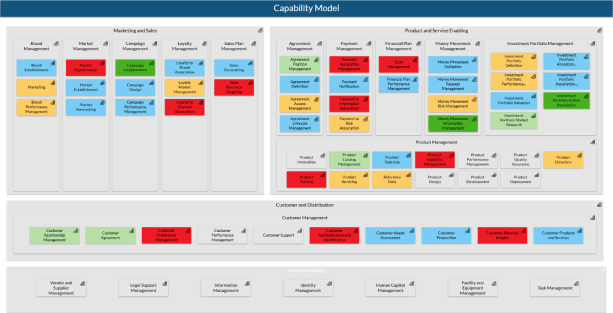
Capability map in BlueDolphin
Generate, Design, and Optimize Processes
BlueDolphin AI helps analysts move from workshop ideas to structured BPMN 2.0 processes in seconds rather than hours.
Process diagrams generated from transcripts, recordings, whiteboards, or prompts remain connected to reusable architecture objects in the repository.
Unlike traditional process modeling tools, BPMN diagrams in BlueDolphin are connected directly to the broader enterprise architecture repository. Activities, applications, business capabilities, data objects, and stakeholders can all be linked to the process, creating a richer understanding of how work is performed and where improvement opportunities exist.
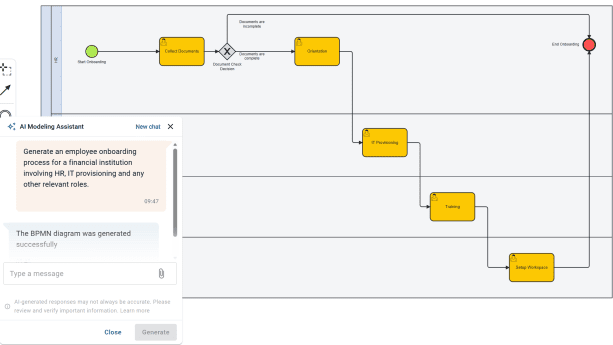
Generate BPMN diagrams in seconds with BlueDolphin AI
Use BPMN as a Shared Language Between Business and IT
In BlueDolphin, BPMN processes are not isolated diagrams. They become a collaboration layer where business analysts, process owners, enterprise architects, solution architects, and delivery teams can align around the same process model.
This makes BPMN more than documentation. It becomes a shared decision-making tool that helps stakeholders align on how work should operate today and how it should evolve in the future.
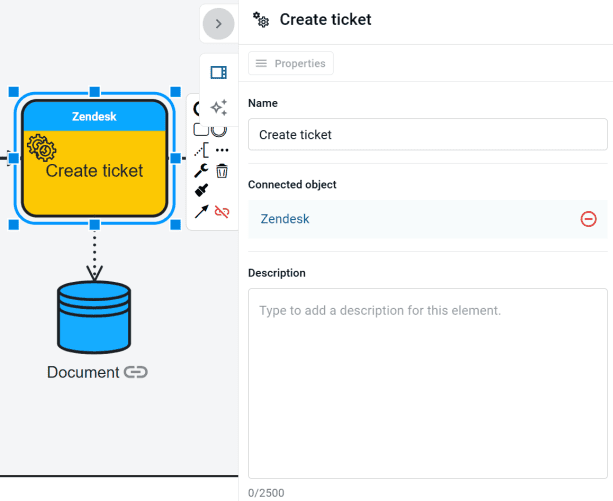
See applications and/or capabilities connected to a process without needing to move views
Analyze Process Impact Before Change Happens
Business analysts can instantly understand how proposed changes affect applications, processes, integrations, and data across the landscape.
Instead of manually investigating impacts, analysts can leverage architecture-driven impact analysis and AI-powered insights to make more confident recommendations.
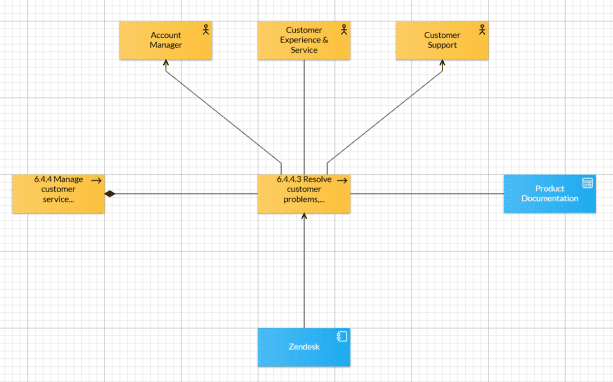
Impact analysis in BlueDolphin
Turn Process Analysis into Solution Design
BlueDolphin helps close the gap between process analysis and solution delivery. Because BPMN processes, requirements, applications, and architecture components are connected, analysts can move directly from process discovery and analysis into solution design.
This enables teams to:
- Trace requirements directly to process activities.
- Connect improvement opportunities to implementation initiatives.
- Promote process changes into solution designs.
- Maintain visibility from analysis through delivery.
The result is less rework, stronger alignment, and a smoother transition from business analysis to execution.
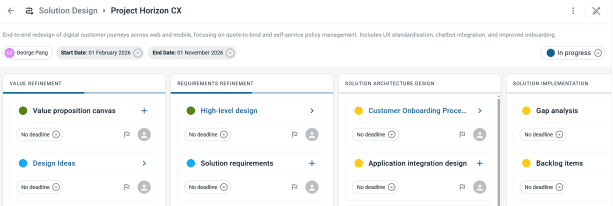
Design solutions end-to-end in one platform
Plan Change Together
Business Analysts can collaborate with stakeholders across business and IT using a shared visual source of truth.
This improves communication, strengthens alignment, and ensures everyone is working from the same information.

Easily tag colleagues and collaborate directly in BlueDolphin
AI-Driven Business Analysis
BlueDolphin AI helps Business Analysts discover opportunities faster by:
- Highlighting dependencies and risks.
- Surfacing optimization opportunities.
- Explaining architecture and process models.
- Accelerating BPMN generation.
- Supporting impact analysis and decision-making.
This allows analysts to focus on delivering value instead of manually gathering and connecting information.
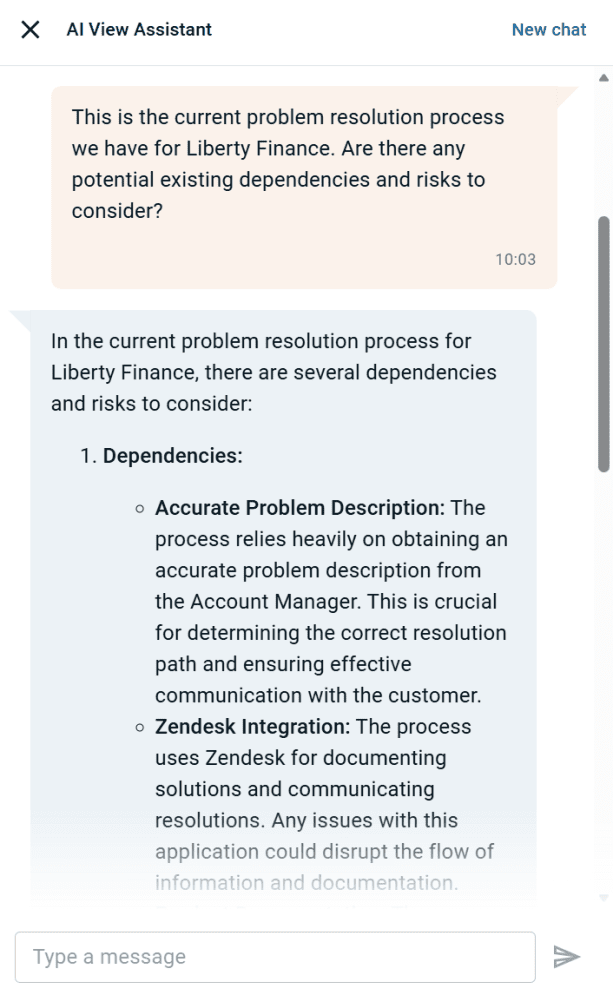
AI View Assistant in BlueDolphin
Move From Analysis to Action
Organizations make better decisions when the right people can work from the same understanding of reality.
Business analysts understand how the business operates. Enterprise architects understand how the organization fits together. Process owners understand how work flows across the enterprise. Solution architects understand how change can be delivered. Executives understand where the organization needs to go.
Too often, these perspectives live in different tools, documents, workshops, and conversations. The result is fragmented information, duplicated effort, and slower decision-making.
BlueDolphin brings these perspectives together around a shared source of truth, helping teams discover opportunities faster, improve collaboration between business and IT, and turn analysis into measurable business outcomes.
When everyone can see how their decisions affect the broader organization, opportunities become easier to identify, recommendations become easier to justify, and change becomes easier to deliver.
Take the next step:
- Learn how Business Analysts and Enterprise Architecture work together in BlueDolphin: Download the solution brief.
- Talk to our team to explore how you can enable more collaboration in your organization.