
Most large organizations do not lack technology. They already have strategy documents, architecture models, project plans, service catalogs, and operational dashboards spread across multiple tools and teams. What they lack is a continuous thread that connects strategy, delivery, and operations into one shared view.
When that thread is missing, transformation becomes harder to steer. Decisions are made with incomplete context, and dependencies emerge only after commitments have been made. Teams optimize within their own domains, but without a shared view, their efforts drift apart.
BlueDolphin closes that gap. Instead of replacing the operational systems organizations already rely on, it connects strategic intent to execution. For organizations using ServiceNow, the fit is especially natural because the two platforms solve different, complementary parts of the transformation journey.
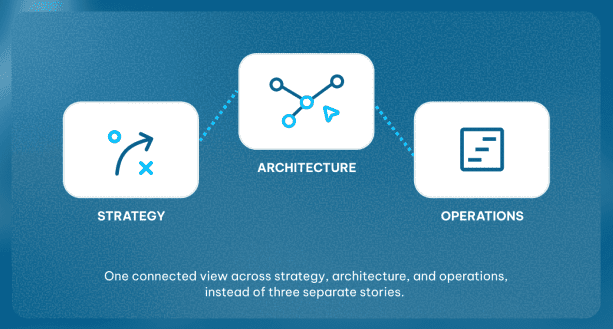
How BlueDolphin complements ServiceNow
Every transformation program has to answer two questions:
- Are we building the right things?
- Are we delivering and running them the right way?
BlueDolphin provides a purpose-built Enterprise Architecture platform that complements ServiceNow’s strategic portfolio capabilities by offering richer architecture modeling, impact analysis and transformation planning.
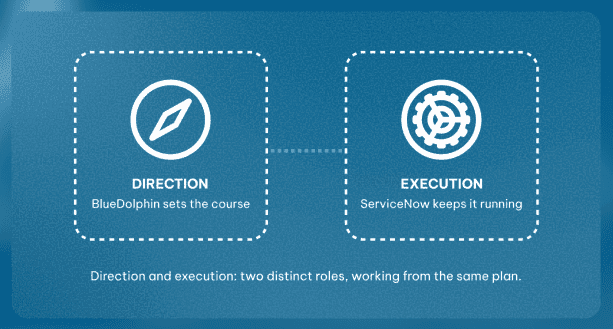
Together, they create a continuous thread from strategy to execution. BlueDolphin determines what should change and how it fits within the enterprise. ServiceNow manages how that change is implemented and operated.
The same split holds true across the entire thread, not just at a high level. Here is what it looks like end-to-end, from the first strategic decision to the daily operational task that carries it out:
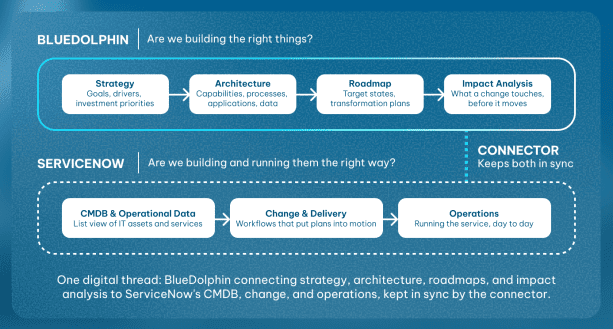
BlueDolphin: The Strategic Layer for ServiceNow
BlueDolphin gives organizations a shared, visual language for the architecture context, helping every initiative to start with a clear understanding of what should change and why.
With BlueDolphin, organizations can:
- See strategy and business capabilities in one place. Instead of this information being scattered across tools and people, both are modeled together in one platform. This enables to see clearly which capabilities support which strategic goals, and where investment will have the most impact.
- Build and maintain a living view of architecture. Applications, processes, data, and technology are connected in one repository, so architects (and business stakeholders) can see how a change in one area ripples through the rest of the organization.
- Plan and govern transformation over time. Roadmaps, target-state designs, and transition plans give organizations a way to move deliberately from where they are today to where they want to be, rather than reacting to change one initiative at a time.
- Run impact analysis before committing. Before a change goes live, teams can see what it touches: which processes, which systems, which dependencies. That visibility turns risk that would otherwise surface late, after budgets are spent and momentum is hard to redirect, into something that is understood up front.
- Make architecture something more people can use, not just specialists. BlueDolphin is built to be visual and accessible, so architecture becomes a shared reference point for business and IT stakeholders alike, not a technical artifact that has to be translated.
What ServiceNow Brings to the Thread
ServiceNow plays an equally important role, and BlueDolphin is designed to complement it, not replace it. Organizations that run ServiceNow have already built a strong operational foundation: a CMDB that tracks IT assets and their relationships, and workflows for demand, change, release, and incident management that keep services running reliably day to day.
That operational strength is exactly why the connection between the two platforms matters. ServiceNow is very good at answering “what do we have, and how is it performing right now?” It is the system many teams already trust for that operational reality. This is precisely the reality that Enterprise Architecture needs to be grounded in.
BlueDolphin’s strength is Enterprise Architecture: a shared, traceable model of how business capabilities connect to the applications, data, interfaces, and technology that deliver them. That is the part of transformation that is easy to talk about in a boardroom and much harder to keep aligned once dozens of teams start acting on it.
Where BlueDolphin and ServiceNow Come Together
The BlueDolphin-ServiceNow connector extends the relationship from complementary platforms to a connected workflow. It synchronizes operational data from ServiceNow with architectural context in BlueDolphin, ensuring both platforms work from the same information.
Changes made in one system are reflected in the other without manual re-entry or a separate import project. It is a capability that quietly removes friction. Architects can work with current CMDB data in BlueDolphin, while ServiceNow users gain access to the business and architectural context behind operational changes without leaving their existing workflows.
The result is a continuous flow from strategy to execution. BlueDolphin defines what should change and why, ServiceNow manages how it is delivered, and the connector keeps both platforms aligned as transformation progresses.
Example: Modernizing Customer Care
Picture a retail bank whose customer care capability is overdue for modernization. Case resolution times have crept up, and the screens agents use every day feel disconnected from the systems actually running behind them.
In BlueDolphin, an architect models the customer care capability and traces what it really depends on: the case management application agents work in, the identity verification interface it calls, the claims processing application it hands off to, and the shared technology component that all three run on. That view makes the true scope of the modernization clear before any work starts. It is not just the one screen agents complain about. It is three applications, two interfaces, and one shared technology component.
With that impact picture agreed, the initiative moves from planning into delivery. The approved scope, along with the applications, interfaces, and technology components it touches, flows into ServiceNow as a change initiative, where the delivery team plans the work, sequences the releases, and manages it through the change and release workflows they already use.
As the work proceeds, ServiceNow’s CMDB, which tracks IT assets and their relationships as Configuration Items, or CIs, keeps reflecting day-to-day reality: which version of the case management application is live, which interface is active, which technology component is now in production. The connector keeps that reality synchronized back into BlueDolphin automatically, so the architecture view stays accurate long after the modernization project itself has closed.
The result: customer care gets a faster, more reliable case experience, and months later, both platforms still agree on what is actually running.
What This Means for Your Enterprise Architecture Practice
If you’re evaluating the future of your Enterprise Architecture practice, especially if you’ve already invested in ServiceNow, the question is not which platform to choose. It is how to get the most value from both. In practice, that means:
- Extend ServiceNow instead of replacing it. Continue using ServiceNow to manage operational execution while adding BlueDolphin as a purpose-built platform for strategy, enterprise architecture, and transformation planning.
- Reuse the data you already trust. The BlueDolphin-ServiceNow connector makes CMDB data immediately available for architecture modeling, impact analysis, and transformation planning, eliminating duplicate data management.
- Make better decisions with complete context. Combine strategic priorities, business capabilities, enterprise architecture, and operational data in a single view, so investment decisions and change plans are based on the full picture.
- Strengthen transformation governance. BlueDolphin provides roadmaps, target-state architectures, and impact analysis that complement ServiceNow’s operational governance, helping organizations guide transformation from planning through execution.
The value of BlueDolphin is not that it replaces ServiceNow. It helps organizations get more from the investment they have already made by adding the strategic and architectural context that ServiceNow was never designed to provide. Together, the two platforms answer both questions every transformation depends on: Are we building the right things, and are we delivering them the right way?
Connect Enterprise Architecture with ServiceNow
Transformation succeeds when strategy, architecture, execution, and operations work from a shared view. BlueDolphin provides the strategic and architectural foundation, while ServiceNow manages operational execution. Together, they connect planning and delivery, helping organizations make better decisions, reduce risk, and keep transformation aligned as it evolves.
Enterprise Architecture delivers the most value when it is connected to execution rather than isolated from it. BlueDolphin and ServiceNow each play a distinct role in that journey, together creating the digital thread from strategic intent to operational reality.
See it in action – Book a demo today.
Download an overview of BlueDolphin and ServiceNow integration: Download the solution brief.
A Closer Look: Platform Roles and CSDM 5 Coverage
Everything above is the full story. What follows is additional detail for architects and other technical stakeholders who want to see the platform split and the CSDM 5 assessment laid out capability by capability. Feel free to skip straight to the closing note if the summary above is all you need.
Platform Roles and Responsibilities
A simple way to see how responsibility divides between the two platforms in practice:
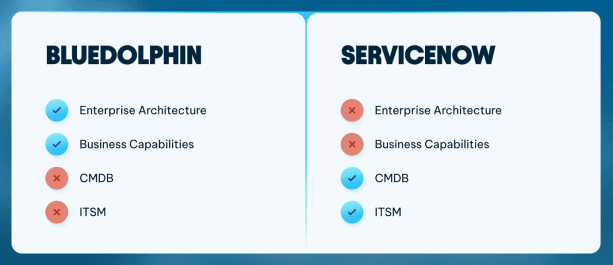
This is a small, illustrative slice of the split rather than a complete list. BlueDolphin also covers value streams, processes, applications, data, standards, target architecture, roadmaps, and transformation governance. ServiceNow also covers ITOM, ITAM, demand, change, release, and incident management. The pattern holds throughout: BlueDolphin covers what sits upstream of execution, ServiceNow covers execution itself.
CSDM 5 Capability Coverage
CSDM 5 (the ServiceNow Common Service Data Model, version 5) is ServiceNow’s model for organizing operational and service-related data. It is a strong foundation for CMDB integration, operational ownership, and service operations. With its most recent update, CSDM 5 also reaches further into strategy and portfolio work than earlier versions did. Where that is the case below, the table notes it, along with whether it depends on ServiceNow’s separately licensed Strategic Portfolio Management (SPM) product to use in practice. Looking at it capability by capability still shows where enterprise architecture work benefits from BlueDolphin alongside it:
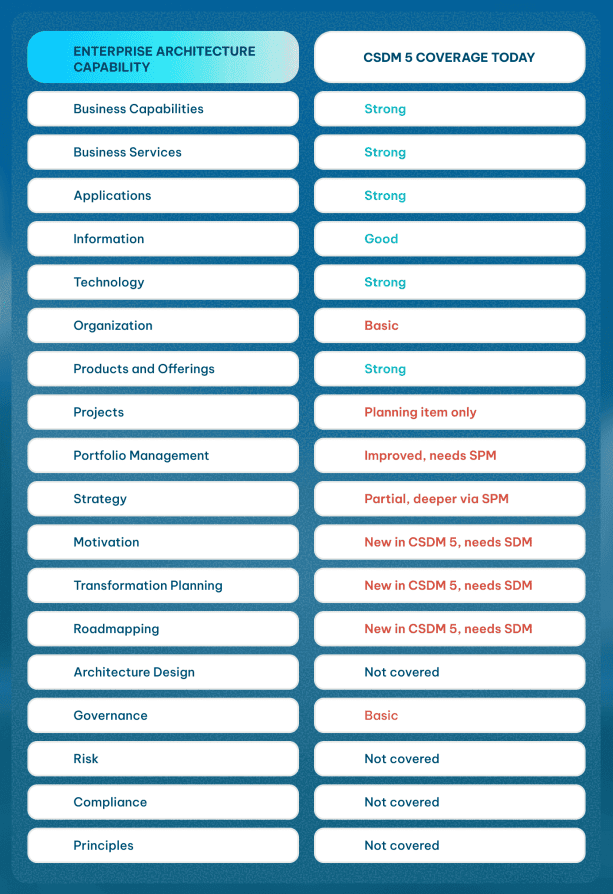
None of this changes the core story. CSDM 5 has started to reach into strategy and portfolio work, but mostly through a separate licensed product, while BlueDolphin includes this natively as part of one platform, with nothing extra to buy. And BlueDolphin still covers ground CSDM 5 does not reach at all: architecture design, risk, compliance, and formal governance principles.