Modern organizations depend on hundreds, and sometimes thousands, of technology components that quietly keep the business running. Operating systems, databases, networking infrastructure, storage platforms, middleware, collaboration tools, and cloud services all require ongoing maintenance, upgrades, and eventual replacement. Yet many organizations manage these assets reactively, responding only when vendors announce end-of-life deadlines or critical systems begin to fail.
Technology Portfolio Management (TPM) provides a structured way to inventory, govern, and evolve an organization’s technology landscape over time. Rather than treating infrastructure decisions as isolated projects, TPM creates a continuous planning process that aligns technology investments with business priorities while reducing operational risk.
In this guide, we’ll explore the fundamentals of Technology Portfolio Management, how it differs from Application Portfolio Management, and how organizations can use it to support long-term business transformation.
WHAT IS TECHNOLOGY PORTFOLIO MANAGEMENT?
Technology Portfolio Management is the practice of managing the underlying technology platforms that support an organization’s applications and business operations. In practical terms, it means maintaining a complete inventory of infrastructure technologies, understanding where they are used, tracking their lifecycle, and planning upgrades or replacements before they become business risks.
The technology portfolio typically includes:
- Operating systems
- Databases
- Storage platforms
- Networking infrastructure
- Backup solutions
- Middleware
- Cloud infrastructure
- Office productivity and collaboration platforms
- Other foundational technology services
Rather than focusing on individual projects, TPM creates visibility across the entire technology landscape so organizations can make informed decisions about modernization, investment, and lifecycle management.
WHY DOES TECHNOLOGY PORTFOLIO MANAGEMENT MATTER?
Without a structured approach to managing technology assets, organizations often become reactive.
Consider an enterprise running thousands of devices on an aging operating system. If the vendor announces the end of support with little preparation, IT teams suddenly face large migration projects with limited time to execute them. Similar situations occur with databases, networking equipment, middleware, storage platforms, and cloud services.
Technology Portfolio Management helps prevent these surprises by providing visibility into technology lifecycles before they become urgent business problems.
Instead of reacting to vendor announcements, organizations can build long-term roadmaps, schedule projects strategically, allocate budgets appropriately, and understand the business impact of technology changes before they occur.
TECHNOLOGY PORTFOLIO MANAGEMENT VS. APPLICATION PORTFOLIO MANAGEMENT
Technology Portfolio Management and Application Portfolio Management (APM) are closely related, but they solve different problems.
Technology Portfolio Management focuses on the foundational technology stack that supports the enterprise. It governs infrastructure technologies that are broadly shared across the organization, including operating systems, databases, storage, networking, middleware, and collaboration platforms.
Application Portfolio Management focuses on the software applications that support specific business functions, such as customer relationship management systems, finance applications, HR platforms, or manufacturing systems.
The two disciplines influence one another but remain separate practices.
For example, upgrading a database platform may affect multiple business applications that depend upon it. Conversely, retiring a business application may reduce demand for certain infrastructure technologies, but it typically has less impact on the broader technology landscape.
Some organizations blur the boundary between TPM and APM, particularly for collaboration suites such as Microsoft 365 or Google Workspace. However, the underlying principle remains consistent: TPM manages the technology foundation, while APM manages the applications built upon it.
THE CORE ELEMENTS OF TECHNOLOGY PORTFOLIO MANAGEMENT
Effective Technology Portfolio Management consists of several core activities that work together to support continuous modernization.
Technology inventory
Organizations must first understand what technologies they operate, where they are deployed, which versions are currently running, and who depends on them.
Without this inventory, lifecycle planning becomes impossible.
Technology function maps
Technology function maps organize infrastructure into logical technology domains and show which products and vendors support each capability across the enterprise.
These maps provide a structured way to understand the technology landscape while exposing opportunities for simplification and standardization.
Technology roadmaps
Vendor roadmaps and lifecycle schedules provide guidance for future upgrades and migrations.
Organizations can use these roadmaps to build multi-year plans rather than waiting for end-of-support announcements.
Governance and planning
Technology Portfolio Management establishes governance around technology standards, lifecycle policies, review processes, and modernization priorities.
Rather than making isolated infrastructure decisions, organizations create repeatable processes for evaluating technology investments over time.
HOW ORGANIZATIONS DECIDE TO UPGRADE, REPLACE, OR RETIRE TECHNOLOGY
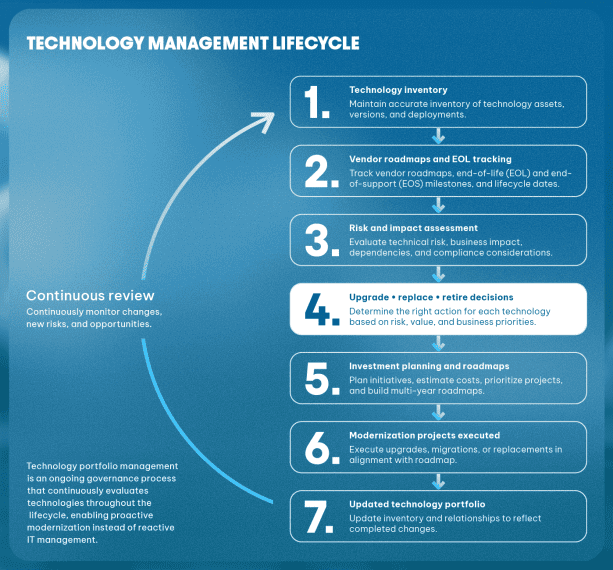
Technology Portfolio Management provides the framework organizations use to make informed lifecycle decisions across their technology landscape. Rather than waiting for systems to become obsolete or unsupported, TPM enables IT leaders to evaluate technologies continuously and plan changes well in advance.
Upgrades are most commonly driven by vendor roadmaps and lifecycle policies. Software vendors regularly release new versions while phasing out support for older ones, requiring organizations to modernize to maintain security, stability, and access to vendor support. By tracking these milestones centrally, organizations can schedule upgrades proactively instead of scrambling to meet unexpected deadlines.
Replacement decisions are typically more strategic. Organizations may choose to replace a technology because a competing solution offers lower costs, stronger capabilities, better integration with the existing environment, or improved scalability for future growth. In many cases, replacement is also driven by standardization efforts, as IT teams seek to reduce the number of vendors and platforms they support.
Technology retirement is less common than upgrading or replacing because most organizations still require the underlying capabilities that technologies provide. Instead of eliminating entire technology categories, they typically retire redundant products after consolidating onto a preferred platform or migrating to newer infrastructure that delivers broader functionality.
These decisions become particularly important following mergers and acquisitions. When two organizations combine, they often inherit overlapping technology stacks with multiple databases, storage platforms, collaboration tools, or networking solutions performing similar functions. Technology Portfolio Management helps organizations identify these overlaps, evaluate business impact, and develop a roadmap for consolidation that reduces complexity while minimizing operational disruption.
Ultimately, effective Technology Portfolio Management transforms lifecycle decisions from reactive responses into deliberate strategic investments, allowing organizations to modernize infrastructure while controlling costs, reducing risk, and supporting long-term business objectives.
WHAT IS A TECHNOLOGY FUNCTION MAP?
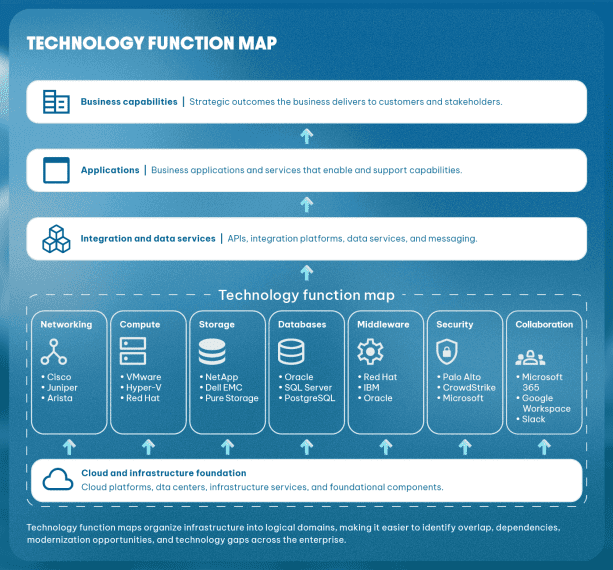
A technology function map is a structured representation of an organization’s technology landscape, organizing infrastructure into logical domains rather than simply cataloging individual products. It provides a standardized framework for understanding which technologies support the enterprise and how those technologies relate to one another.
Instead of maintaining a long inventory of disconnected hardware and software assets, a technology function map groups technologies into categories such as networking, compute, storage, databases, middleware, security, cloud infrastructure, integration services, and collaboration platforms. Within each domain, organizations can identify the specific vendors and products currently delivering that capability.
This structured view creates a common language for IT and business stakeholders, making complex technology environments easier to understand and govern. Rather than focusing on individual products in isolation, decision-makers can evaluate entire technology domains, compare solutions that perform similar functions, and identify opportunities to simplify the overall architecture.
Technology function maps also provide the foundation for broader Technology Portfolio Management activities. By visualizing the relationships between technologies, applications, and business capabilities, organizations gain a clearer understanding of where critical dependencies exist and where future investments should be prioritized. The result is greater transparency across the technology landscape and a more strategic approach to technology planning and modernization.
WHAT BECOMES VISIBLE WHEN YOU MAP THE TECHNOLOGY LANDSCAPE?
Technology function maps provide a level of visibility that is difficult to achieve through spreadsheets or static asset inventories alone. By organizing technologies into functional domains and showing the products and vendors that support each capability, organizations gain a holistic view of their technology environment and the relationships within it.
This structured view makes it easier to uncover opportunities and risks that might otherwise remain hidden. For example, organizations can quickly identify:
- Technology overlap across departments, where multiple solutions provide the same capability
- Redundant vendors and products that increase licensing costs and operational complexity
- Opportunities for standardization and consolidation to simplify the technology stack
- Gaps in technology coverage, where essential capabilities may be missing or underdeveloped
- Dependencies between technology layers and business applications, helping teams understand the downstream impact of infrastructure changes
- Areas where modernization should be prioritized, particularly for aging technologies approaching end of support or end of life
This level of transparency supports better governance and more strategic decision-making. Instead of managing technologies in isolation, IT leaders can evaluate the portfolio as a whole, balancing cost, risk, functionality, and business impact. The result is a more standardized, resilient, and future-ready technology landscape that is easier to maintain and evolve over time.
HOW END-OF-LIFE RISK INFLUENCES TPM DECISIONS
End-of-life (EOL) risk is one of the biggest drivers of Technology Portfolio Management because nearly every technology an organization depends on is governed by a vendor lifecycle. Software vendors eventually stop releasing updates, discontinue support, or retire products altogether, forcing organizations to decide whether to upgrade, replace, or accept increasing operational and security risk.
Without a structured approach to managing these milestones, organizations often find themselves scrambling to respond to unexpected deadlines. Technology Portfolio Management brings those timelines into view, allowing IT leaders to incorporate them into long-term planning instead of treating them as emergencies.
A mature TPM practice helps organizations:
- Track vendor roadmaps and upcoming end-of-support dates across the technology portfolio
- Prioritize modernization projects based on business impact and technical risk
- Coordinate upgrades with application owners and business stakeholders
- Spread investments over multiple budget cycles rather than funding urgent, unplanned projects
- Reduce operational disruption by scheduling migrations well before support expires
Instead of reacting to vendor announcements, organizations can align technology lifecycle management with strategic planning and execute modernization initiatives on their own timetable.
A SIMPLE EXAMPLE OF TPM IN PRACTICE
Consider an organization that relies on a database platform supporting dozens of business-critical applications. The platform has been stable for years, so it receives little attention until the vendor announces that support for the current version will end in eighteen months.
Without Technology Portfolio Management, the announcement triggers a fire drill. IT teams must first determine where the database is deployed, which applications depend on it, whether integrations will be affected, and how much the migration will cost. Business leaders suddenly face unexpected project work, budget requests, and potential disruption to critical operations.
Organizations with a mature TPM practice take a very different approach. Because the technology portfolio is already inventoried and mapped, they can quickly answer questions such as:
- Which applications depend on this database?
- Which business processes could be affected by the upgrade?
- Are there opportunities to consolidate or modernize at the same time?
- How much investment will be required over the next budget cycle?
- What is the optimal timeline for completing the migration?
Instead of responding to a crisis, the organization executes a planned modernization initiative that aligns with broader business and technology objectives.
HOW TPM SUPPORTS LONG-TERM TECHNOLOGY INVESTMENT
Technology Portfolio Management changes the conversation from “What do we need to fix today?” to “What investments will position the organization for the future?”
By maintaining visibility into technology lifecycles and vendor roadmaps, organizations can forecast infrastructure needs years in advance instead of reacting to unexpected events. This creates a more predictable approach to budgeting and allows modernization initiatives to compete for funding alongside other strategic priorities.
Long-term technology roadmaps help organizations:
- Forecast future upgrade and replacement projects
- Estimate infrastructure spending over multiple years
- Align technology investments with business transformation initiatives
- Prioritize modernization efforts based on risk and business value
- Reduce financial surprises caused by emergency technology refreshes
The result is a technology investment strategy that supports both operational stability and long-term business growth.
COMMON MISCONCEPTIONS ABOUT TPM
Technology Portfolio Management is often misunderstood because it overlaps with several adjacent disciplines. While the concepts are related, TPM serves a distinct purpose within Enterprise Architecture and IT governance.
Some of the most common misconceptions include:
- “TPM is the same as Application Portfolio Management.” In reality, TPM manages the underlying technology stack, while APM focuses on business applications.
- “TPM automatically upgrades technology.” TPM provides visibility and planning, but organizations must still execute the modernization projects themselves.
- “TPM is just an inventory exercise.” Maintaining an inventory is only the starting point. Mature TPM includes governance, lifecycle planning, investment management, and strategic decision-making.
- “TPM is only useful for large enterprises.” Organizations of all sizes benefit from understanding their technology landscape and proactively managing lifecycle risk.
Ultimately, TPM is less about documenting technology than enabling better business and investment decisions.
HOW TPM CONNECTS TO ENTERPRISE ARCHITECTURE
Technology Portfolio Management represents the technology layer within Enterprise Architecture, providing visibility into the infrastructure that enables applications and business capabilities to function. Every business process depends on applications, and every application relies on an underlying technology stack that must be managed throughout its lifecycle.
This relationship creates a direct connection between technology decisions and business outcomes. A change to a database platform, networking service, or middleware component can have downstream effects across dozens of applications and business processes.
By integrating TPM into Enterprise Architecture, organizations gain visibility into:
- How technologies support business capabilities
- Which applications depend on specific infrastructure components
- The impact of technology changes across the enterprise
- Opportunities to standardize and simplify the technology landscape
- Technology risks that could affect strategic initiatives
This end-to-end perspective enables technology leaders to make infrastructure decisions that support broader business transformation goals.
BLUEDOLPHIN’S APPROACH TO TECHNOLOGY PORTFOLIO MANAGEMENT
BlueDolphin supports Technology Portfolio Management by providing a centralized repository that captures technology assets, their relationships, and their role within the broader enterprise architecture. Instead of relying on disconnected spreadsheets or siloed documentation, organizations gain a single source of truth for managing their technology landscape.
Technology function maps and technology roadmaps provide visual insight into technology domains, vendor relationships, and lifecycle planning, helping organizations understand not only what technologies they own but also how those technologies support business operations.
By connecting technologies to applications and business processes, BlueDolphin enables organizations to:
- Build comprehensive technology inventories
- Visualize dependencies across the technology stack
- Create technology roadmaps for modernization planning
- Perform impact analysis before making infrastructure changes
- Support strategic investment and governance decisions through a connected architecture model
This integrated approach helps organizations move beyond asset management toward proactive technology governance and business-aligned planning.
WHAT DOES GOOD TECHNOLOGY PORTFOLIO MANAGEMENT LOOK LIKE?
Effective Technology Portfolio Management is not a one-time exercise but an ongoing governance discipline that evolves alongside the organization. Mature TPM practices combine accurate technology inventories with continuous lifecycle management, strategic planning, and regular review processes that keep the technology landscape aligned with business priorities.
Organizations with mature TPM capabilities typically have several characteristics in common:
- A comprehensive inventory of technology domains, vendors, and products
- Regular reviews of vendor roadmaps and lifecycle milestones
- Technology roadmaps that guide upgrades, replacements, and retirements
- Governance principles that promote consistency and standardization
- Investment planning tied to long-term business and transformation goals
- Processes that translate planning into actionable modernization projects
Rather than reacting to unexpected technology changes, these organizations continuously evaluate their portfolio, prioritize investments, and modernize infrastructure before it becomes a source of operational risk. The result is a technology landscape that is easier to govern, less costly to maintain, and better positioned to support future business transformation.
Turn Technology Complexity into Strategic Clarity
Technology Portfolio Management is most effective when organizations have a complete, connected view of their technology landscape. BlueDolphin helps teams inventory technology assets, visualize dependencies, build technology roadmaps, and make informed modernization decisions that align IT investments with business strategy.
Book a personalized demo to see how BlueDolphin can help you manage your technology portfolio with confidence.