

Most organizations do not struggle to define strategy but are challenged to deliver on it.
Plans are built and priorities are set. Investments are approved. But once execution begins, alignment starts to drift. Teams move quickly within their own domains, making rational decisions based on what they can see. Over time, those decisions accumulate into something unintended. Initiatives lose connection to original goals. Outcomes become harder to measure.
Capability-based planning is meant to solve this. It provides a way to anchor transformation in what the business must actually be able to do, rather than in disconnected projects or shifting priorities.
In practice, however, many organizations stop at the model. Capabilities are mapped, documented, and occasionally referenced. But they are not actively used to guide decisions, prioritize investments, or track progress. The result is a familiar gap between strategy and execution.
Capability-based planning closes that gap when it is treated not as an exercise, but as a system. A system that connects strategic intent to the capabilities required to deliver it, and then links those capabilities directly to execution and measurable outcomes.
This guide explores how capability-based planning works, why it often falls short, and how organizations can use it to turn architecture into a driver of real business impact.
What is Capability-Based Planning—and why does it matter?
Capability-based planning starts with a simple premise: transformation should be guided by what the business needs to be able to do.
A capability represents a stable business ability. It is not tied to a specific team, system, or initiative. It reflects an outcome the organization must consistently deliver, regardless of how the underlying environment changes.
Capability-based planning uses this foundation to connect strategy to execution. Instead of starting with projects, it starts with capabilities, assesses how well they perform, and determines where investment is needed to support business goals.
This shift matters because capabilities persist. Strategies evolve, technologies change, and initiatives come and go. Capabilities remain. They provide a stable structure for making decisions in a constantly changing environment. When used effectively, capability-based planning brings clarity to areas that are often fragmented or difficult to manage.
For the CFO
Capability-based planning connects investments directly to business value.
Rather than evaluating spend in isolation, finance leaders can see how funding decisions support specific capabilities and, in turn, strategic outcomes. It becomes easier to identify redundancy, prioritize investments, and understand the impact of trade-offs. This level of visibility supports more confident decision-making and a clearer view of return on investment.
For business transformation leaders
Capability-based planning provides a way to keep strategy aligned during execution.
Transformation efforts rarely fail at the starting point. They begin to break down as work progresses and assumptions diverge. Capability-based planning creates a shared reference point that helps teams stay aligned, even as conditions change.
It allows leaders to identify gaps early, adjust priorities with context, and ensure that initiatives continue to support the intended outcomes.
For IT and architecture teams
Capability-based planning connects technical decisions to business impact.
Systems, applications, and data are no longer managed in isolation. They are understood in terms of the capabilities they enable. This makes it easier to prioritize modernization efforts, manage dependencies, and ensure that technical work remains relevant to the business.
It also shifts architecture from a descriptive role to an active one, where it directly informs planning and execution.
Capability-based planning matters because it brings structure to complexity.
It creates a shared understanding of what the business needs to do, aligns decisions around that understanding, and provides a way to measure progress over time. When applied consistently, it turns capabilities into more than a model. It turns them into a foundation for how change is planned, executed, and evaluated.
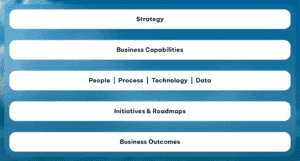
Core components of Capability-Based Planning
Capability-based planning only works when it is grounded in a clear, shared structure. Without that, it becomes another abstract model that looks useful but does not hold up under real-world pressure.
At its core, capability-based planning brings together a set of elements that define how the business operates, how it delivers value, and where change is needed.
Capability mapping
Everything starts with a clear view of what the business must be able to do.
A capability map defines these abilities in a structured way, independent of how they are currently implemented. It creates a common language that can be understood across finance, business, and IT, removing ambiguity and reducing the risk of misalignment.
Done well, capability mapping does more than document the organization. It exposes gaps, overlaps, and dependencies that are often hidden in day-to-day operations.
Capability hierarchy
Not all capabilities carry the same weight.
A structured hierarchy helps distinguish between:
- Strategic capabilities that differentiate the business
- Core capabilities that sustain operations
- Supporting capabilities that enable the rest
This distinction matters when decisions need to be made. It allows leaders to focus investment where it will have the greatest impact, rather than spreading resources evenly across the organization.
Capability dimensions
Capabilities do not exist in isolation. They are realized through a combination of:
- People
- Processes
- Technology
- Data
Looking at capabilities through these dimensions provides a more complete picture of performance. A capability may appear strong on the surface but be constrained by outdated systems, inefficient processes, or gaps in skills.
This multi-layer view is what makes capability-based planning actionable rather than theoretical.
Capability relationships
Capabilities are part of a broader system.
They connect to value streams, customer journeys, applications, and underlying technology. Understanding these relationships is essential for evaluating the true impact of change.
When one capability is improved or disrupted, the effects are rarely contained. They ripple across the organization. Mapping these connections makes those impacts visible before decisions are made, not after.
Taken together, these components create a foundation that is both stable and flexible. Stable enough to support long-term planning, and flexible enough to adapt as the business evolves.
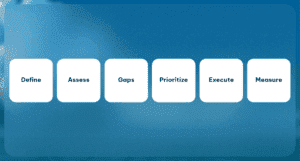
From capabilities to action: How Capability-Based Planning works
Defining capabilities is not the goal. Using them to guide decisions is.
Capability-based planning becomes valuable when it moves beyond mapping and turns into a repeatable process for identifying where to act and how to measure progress.
- Define capabilities
The first step is establishing a clear and consistent capability model.
This includes defining capabilities at the right level of detail and ensuring that they reflect how the business actually operates, not how it is assumed to operate. The goal is not perfection. It is alignment.
A usable model is one that stakeholders recognize and can work from.
2. Assess capability performance
Once capabilities are defined, the next step is understanding how well they perform.
This typically involves evaluating maturity, effectiveness, and strategic importance. The goal is to identify where capabilities are strong, where they are underperforming, and where they are critical to future success.
Without this step, capability maps remain static. With it, they become a tool for prioritization.
3. Identify gaps
Gaps emerge when current capability performance does not support strategic objectives.
Some gaps are obvious. Others only become visible when capabilities are evaluated in context. For example, a capability may function adequately today but fall short under future demands.
This step requires looking forward as well as assessing the present.
4. Prioritize investments
Not every gap needs to be addressed at once.
Capability-based planning provides a structured way to prioritize based on impact. Strategic capabilities that are underperforming will typically rise to the top. Supporting capabilities may be addressed later or improved incrementally.
This approach shifts decision-making away from urgency and toward value.
5. Align execution
Once priorities are set, initiatives can be aligned directly to capabilities.
This creates a clear line of sight between what the business is trying to achieve and the work being done to support it. It also makes it easier to coordinate efforts across teams, reducing duplication and conflicting initiatives. Execution becomes more intentional and easier to manage.
6. Measure impact
The final step is often the one that is overlooked.
Capabilities provide a way to measure whether change is delivering the intended results. Improvements can be tracked over time, and initiatives can be evaluated based on their contribution to capability performance. This closes the loop between planning and outcomes.
Capability-based planning is an ongoing process. As strategies evolve and conditions change, capabilities can be reassessed, priorities adjusted, and execution realigned. This creates a continuous cycle of improvement, where decisions are grounded in a consistent understanding of what the business needs to do and how well it is doing it.
Common Challenges in Capability-Based Planning
Capability-based planning is widely understood in theory. The challenge is making it work in practice. Many organizations invest time in defining capabilities, only to see the effort lose momentum. The model exists, but it does not influence decisions. It becomes another artifact that is referenced occasionally and then set aside. This breakdown is not caused by a lack of effort. It is usually the result of how capability-based planning is applied.
Capability models that go stale
Capability maps are often created as part of a strategic initiative and then left unchanged. As the business evolves, the model quickly becomes outdated. Stakeholders lose confidence in its accuracy and stop relying on it. Without continuous updates, even well-structured capability models lose relevance.
No connection to execution
One of the most common issues is the disconnect between capabilities and the work being done. Capabilities are defined at a high level, while initiatives are planned and executed separately. Without a direct link between the two, it becomes difficult to ensure that investments are improving the capabilities that matter most. This is where many transformation efforts begin to drift.
Lack of measurable outcomes
Capabilities are often described, but not measured. Without clear metrics, it is difficult to assess whether a capability is improving or whether an initiative is delivering value. Progress is inferred rather than demonstrated, which weakens decision-making over time.
Overly complex models
In an effort to be comprehensive, some organizations create capability models that are too detailed to be usable. When models become difficult to navigate or understand, they limit participation. Capability-based planning becomes the responsibility of a small group rather than a shared framework for decision-making. Simplicity and clarity are what make the model effective.
Limited adoption across the organization
Capability-based planning is sometimes treated as an architecture exercise rather than a business discipline. When finance, business leaders, and IT teams are not aligned around the same model, its impact is reduced. The value of capability-based planning comes from shared understanding and consistent use, not from isolated analysis.
The pattern across these challenges is consistent. The issue is not defining capabilities. It is operationalizing them. Capability-based planning only delivers value when it becomes part of how decisions are made, not just how the organization is described.
Capability-Based Planning use cases
When applied consistently, capability-based planning becomes a practical tool for navigating complex decisions.
It provides a structured way to evaluate options, prioritize investments, and understand the impact of change across the organization.
Strategic planning and prioritization
Capability-based planning brings focus to strategic decision-making.
By identifying which capabilities are most critical to achieving business objectives, leaders can prioritize investments with greater confidence. This reduces the risk of spreading resources too thin and ensures that efforts are aligned with long-term goals.
Digital transformation
Transformation initiatives often involve multiple moving parts across business and technology.
Capability-based planning provides a way to coordinate these efforts. It ensures that initiatives are not pursued in isolation, but as part of a broader plan to improve the capabilities that drive value.
This helps maintain alignment as transformation progresses.
Mergers and acquisitions
During mergers and acquisitions, organizations need to quickly understand how two operating models fit together.
Capability-based planning provides a neutral framework for comparison. It highlights overlaps, gaps, and opportunities for consolidation, making integration more structured and less disruptive.
Application rationalization
Many organizations manage a large and complex application landscape.
By linking applications to the capabilities they support, it becomes easier to identify redundancy, assess value, and prioritize modernization efforts. Decisions are no longer based solely on technical considerations, but on business impact.
Cost optimization
Cost reduction efforts are often reactive and broad in scope.
Capability-based planning allows organizations to take a more targeted approach. By understanding which capabilities are critical and which are less strategic, leaders can make more informed decisions about where to reduce or reallocate spending.
Operational improvement
Capability-based planning can also be applied at a more granular level to improve day-to-day operations. By assessing capability performance across people, processes, technology, and data, organizations can identify inefficiencies and implement focused improvements that deliver measurable results. These use cases highlight a common theme: Capability-based planning provides a way to make decisions with context.
It connects individual actions to a broader understanding of how the business operates and where it needs to improve. This makes change more intentional, more coordinated, and more effective over time.
BlueDolphin’s approach to Capability-Based Planning
Capability-based planning only works when it is kept current, connected, and usable across the organization. That is where many approaches fall short. Models are built, but they are not maintained. Insights are generated, but they are not tied to execution.
BlueDolphin addresses this by turning capability-based planning into a connected, continuously updated system.
Capabilities are not defined in isolation. They are mapped end to end and linked directly to value streams, applications, data, and technology. This creates a clear view of how the business operates and how change in one area affects the rest.
Instead of starting from a blank canvas, teams can generate capability models using built-in industry references and AI-assisted modeling. These models can be refined over time, ensuring they remain aligned with how the business actually evolves.
Capability performance is assessed across multiple dimensions, making it possible to understand not just what exists, but how well it works. Gaps become visible in context, and priorities can be set based on impact rather than assumption.
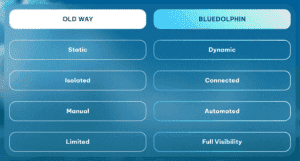
Most importantly, capabilities are connected directly to execution. Initiatives, roadmaps, and projects are linked back to the capabilities they are intended to improve. This creates a clear line of sight between strategy, planning, and delivery. As a result, capability-based planning becomes more than a framework. It becomes a system that supports continuous alignment, informed decision-making, and measurable progress over time.

Turning Capabilities into Drivers of Transformation
Capability-based planning reaches its full value when it moves beyond structure and begins to shape how the organization operates.
Capabilities provide a stable foundation in an environment that is constantly changing. They create a shared understanding of what the business must be able to do and make it possible to align decisions around that understanding.
When capabilities are actively used to guide planning and execution, several things change.
Strategy remains connected to delivery, even as conditions shift. Investments are prioritized based on impact, not urgency. Progress is measured in terms of capability improvement, rather than activity completed.
This is what turns transformation from a series of initiatives into a coordinated effort.
Over time, the organization builds a clearer view of where it is strong, where it needs to improve, and how change is actually delivering value. Decisions become more consistent. Trade-offs become more transparent. Outcomes become easier to explain.
Capability-based planning does not eliminate complexity. It makes it manageable. When supported by the right systems and applied consistently, it allows organizations to move with greater clarity and confidence, ensuring that change is not only delivered, but sustained.
See how capability-based planning works in practice
Discover how BlueDolphin helps you connect capabilities to execution, prioritize with confidence, and measure real business impact.